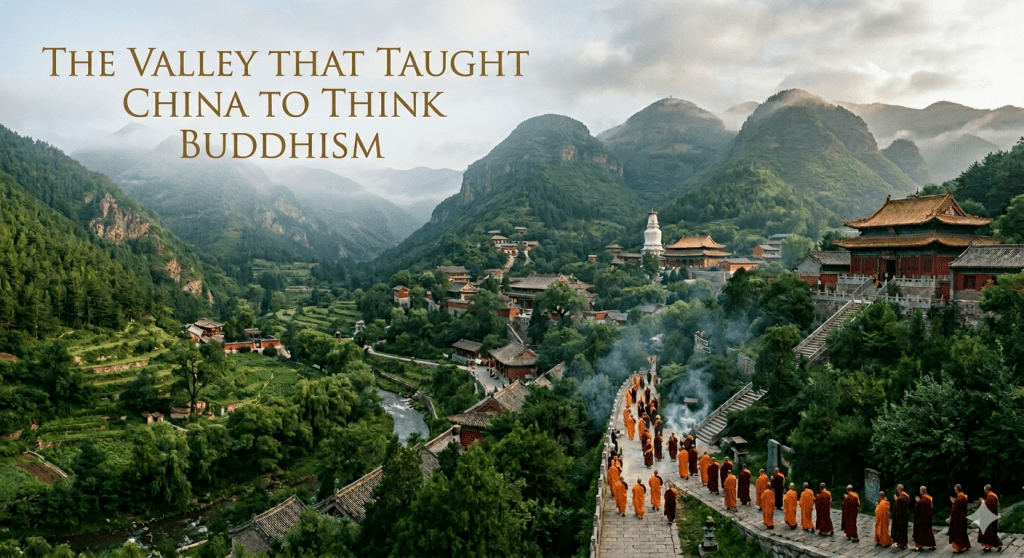
Kanishka’s council lit a fire of enthusiasm among Kashmiris who carried the philosophy of Buddhism across the difficult passes into the land of China. The new philosophy produced a great controversy in China, and one has only to compare the China of the Tangs with the China of the Hans to understand the influence of Kashmiri scholars and the philosophical uproar they brought in China.
According to Hun Tsiang, Buddhism was introduced in China during the reign of King Vinayasambhava, around 170 years after the foundation of Khotan. Khotan as such was not a just passive stop on the Silk Route. It was a civilizational buffer:
geographically between Kashmir and China, culturally between Indic and Sinic worlds, linguistically hybrid (Sanskrit, Prakrit, Khotanese, Chinese).
A monk named Vairocana had come to Khotan from Kashmir. He is said to have introduced a new language as well as Mahayana philosophy. Vijayasambhava built for him a great monastery of Tsarma outside the capital.
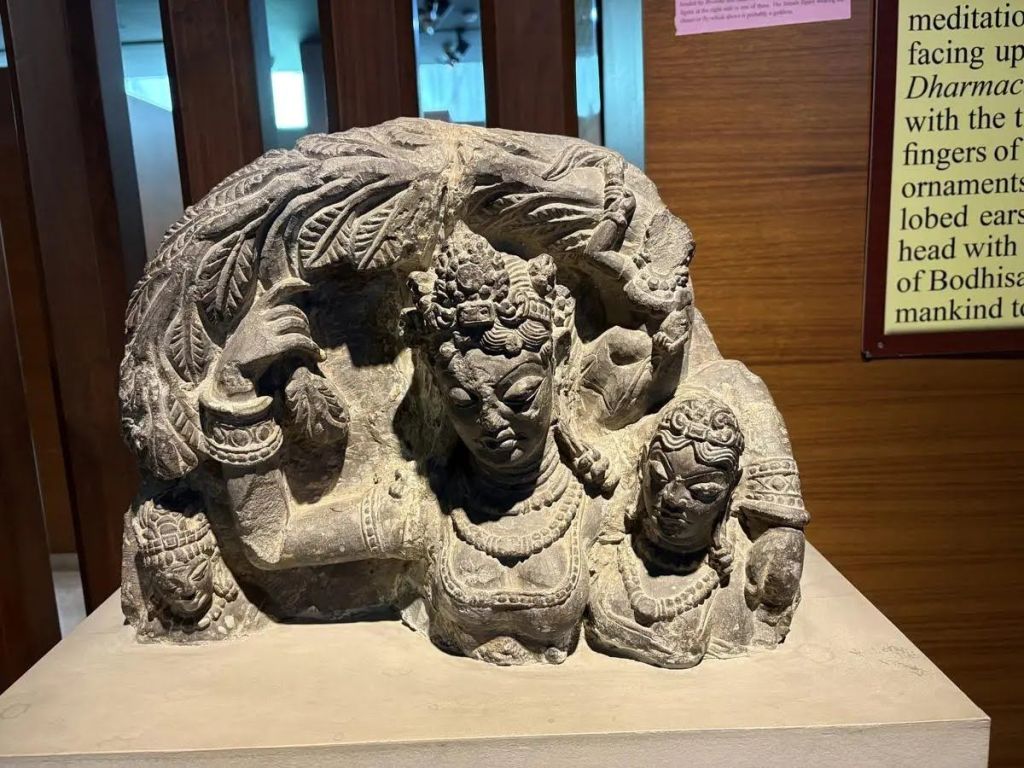
Asvaghosha is believed to have been the first Sanskrit dramatist and is considered the greatest Indian poet prior to Kalidasa. It seems probable that he was the contemporary and spiritual adviser of Kanishka in the first century of our era. He was the most famous in a group of Buddhist court writers whose epics rivaled the contemporary Ramayana. Whereas much of Buddhist literature prior to the time of Asvaghosha had been composed in Pali and Prakrit, Asvaghosha wrote in Classical Sanskrit. He may have been associated with the Sarvastivada or the Mahasanghika schools. It is said that Kanishka had acquired him as a part of war indemnity, and he was allowed to continue his scholarly pursuits in Kashmir, supposedly at Gushi in Handwara.
Kashmir during these days was a flourishing centre of Buddhism, especially of its most powerful sect, Sarvastivada.
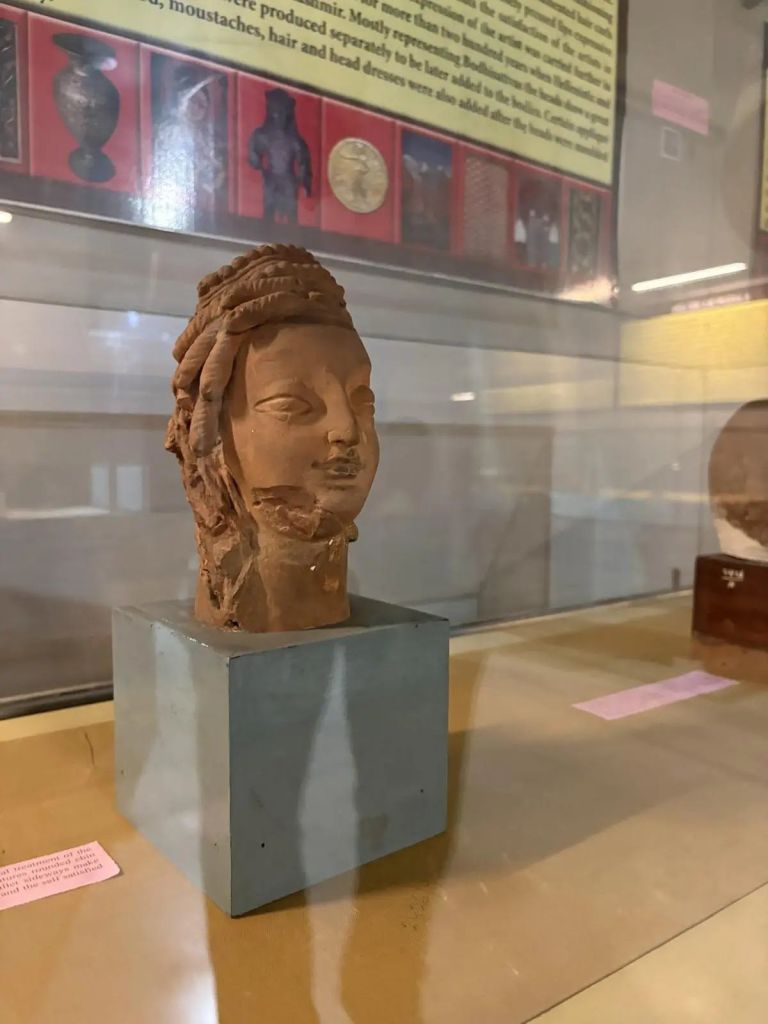
Most of the missionary activity of Kashmir is centred around the celebrated Kumarajiva. He received his education in Kashmir and came in contact with numerous Kashmiri scholars.
Kumarajiva’s father had migrated to Kucha. At just nine years old, his mother brought him to Kashmir for advanced study, where he trained under the Buddhist scholar Bandhudatta. His brilliance drew such admiration that when he returned to Kucha, a large contingent of Kashmiri scholars accompanied him. There he established a monastery, translating Sanskrit Buddhist texts with his Kashmiri collaborators and explaining them to Central Asian and Chinese audiences. Captured in 383 C.E by a Chinese general, he eventually reached the Chinese capital in 401 C.E, joined later by many of his Kashmiri monks. He died there in 413 C.E, and his most celebrated translation—the Lotus Flower Scripture of the Mysterious Law—succeeded where all previous versions had failed, becoming a landmark of Chinese Buddhism. His two key collaborators were Yasa and Vimalaksa, both Kashmiris.
Early Chinese translators struggled with lack of equivalents for Sanskrit philosophical terms, differences in grammar, ontology, and metaphysics. Kashmiri scholars solved this by coining new conceptual vocabulary, adapting Daoist and Confucian terms to Buddhist meaning, and creating a hybrid philosophical language. Kashmiri scholars were among the principal architects of Chinese Buddhism, shaping its language, philosophy, and institutional structure during its formative centuries.
A Kashmiri monk, Sanghabhuti, reached the northern capital of China in 381 C.E. At the request of Chinese scholars, he translated Buddhist texts like the Vinayapitaka from Sanskrit to Chinese and also wrote an exhaustive commentary on it.
During the same time, GautamaSangha travelled from Kashmir to the capital of China with his numerous Kashmiri aides and followers. He reached Chang’an in 348 C.E. A master of Abhidharma, he translated numerous Buddhist texts, revised earlier translations, and wrote several original books on this branch of Buddhist philosophy- all in fluent Chinese. He then moved to Lushan in southern China in 391 C.E, where he again worked with his Kashmiri collaborators to translate texts and propagate Buddhist doctrine. From there he went to Nanking, gained influence among the ruling classes, and had a monastery built for him. Two other Kashmiri scholars closely associated with Kumarajiva—Punyatrata and his pupil Dharmayasa—also made the journey to China. Dharmayasa, son of a Kashmiri Brahmin, left Kashmir at 30, travelled extensively across Asia converting people, and in China worked alongside a large network of Kashmiri scholars before eventually returning, likely to Kashmir.
Perhaps the most dramatic story of Buddhayasas is that he was actively hostile to Buddhism until divine retribution struck and his hand was paralysed after he attacked a wandering monk. In atonement, the Brahmin offered his thirteen-year-old son Yasa to the monk’s fold. After rigorous training in Buddhist texts, Yasa left Kashmir at 27 to preach in China. His first stop, Kashgar, saw him captivate the city’s chief among three thousand monks through sheer learning and demeanour the chief became his devout follower and kept him there for years. It was in Kashgar that Yasa encountered Kumarajiva, and the two Kashmiri-connected scholars joined forces. When Kumarajiva was taken prisoner to China, Yasa was heartbroken and longed to follow. Through the intercession of the Chinese Emperor, he was eventually allowed to join Kumarajiva at Chang’an, where he continued translating works into Chinese. When Kumarajiva died, Yasa lost heart and returned to Kashmir. Between 410–413 C.E he had translated four works into Chinese, including the Dirghagama and Dharmaguptaka Vinaya.
Vimalakasa was one more Kashmiri collaborator of Kumarajiva. He worked with him in China from 406 to 413, translating several works.
Buddhajiva was a collaborator and companion of Fa-Hien and reached China by sea in 423. During his travels in China, Fa-Hien had collected a large number of Sanskrit manuscripts, some of which were later translated by Buddhajiva into Chinese.
Gunavarman was a prince of Kashmir’s royal family, born into exile after his grandfather Haribhadra was banished as a tyrant. Despite this troubled lineage, he mastered Buddhist scriptures from childhood. When the king of Kashmir died without an heir and the nobles invited Gunavarman to take the throne, he refused—so consumed was he by missionary zeal. Instead, he embarked on a pilgrimage through India, then Ceylon, where he reformed local customs, and finally Java. Fa-Hien had reported that in 418 C.E Buddhism was negligible in Java and Brahminism dominant. Within just a few years, Gunavarman had converted the Javanese king and his entire family, and the population followed. Being Kashmiri, he was most likely a Sarvastivadin, which directly explains why that particular school of Buddhist philosophy took root among Javanese Buddhists. His fame spread across the islands, and eventually the Chinese Emperor himself sent emissaries to bring him to Nanking, which he reached in 431 C.E, converting nearly all islands along the way. The Emperor personally received him and built him a magnificent monastery. He died in Nanking in 432 C.E. In the final year alone, he produced fourteen translated or original works.
Dharmamitra, a Kashmiri teacher of meditation, evaded frontier guards to reach China, founded a monastery at Tun-huang, translated twelve Buddhist texts, and lived in south China until his death.
Buddhavarman, another Kashmiri specialist, translated the massive Mahavibhasa Sastra in 60 chapters between 437–439 C.E. Ratnacinta, from a Kashmiri royal family, reached Lo-yang in 693 C.E, founded a monastery called “The Monastery of India,” and translated seven Sanskrit works before dying in 721 C.E. In the 10th century, the Kashmiri T’ien-si-tsai was placed by the Chinese Emperor in charge of an entire board of translators, through whose efforts Chinese Buddhist literature was enriched by over two hundred works.
Even Buddhibhadra—a descendant of Buddha’s own uncle—came to Kashmir at seventeen to study, was inspired by tales of Kashmiri workers in China, and left from Kashmir to become one of the great translators of the age.
The recurring pattern across all these accounts is unmistakable: Kashmir was the intellectual nursery, the training ground, and the sending station for the monks who built Chinese Buddhism from the ground up. It was the high school of Buddhist teaching, and Kashmiri missionaries kindled the fire of adventure in Indian monks from across the subcontinent. The students who came to Kashmir for higher studies, heard stories of Kashmiri exploits in China, and then followed in their footsteps.
Kashmir was not merely a participant in the spread of Buddhism across Asia; it was its engine.


Leave a Reply