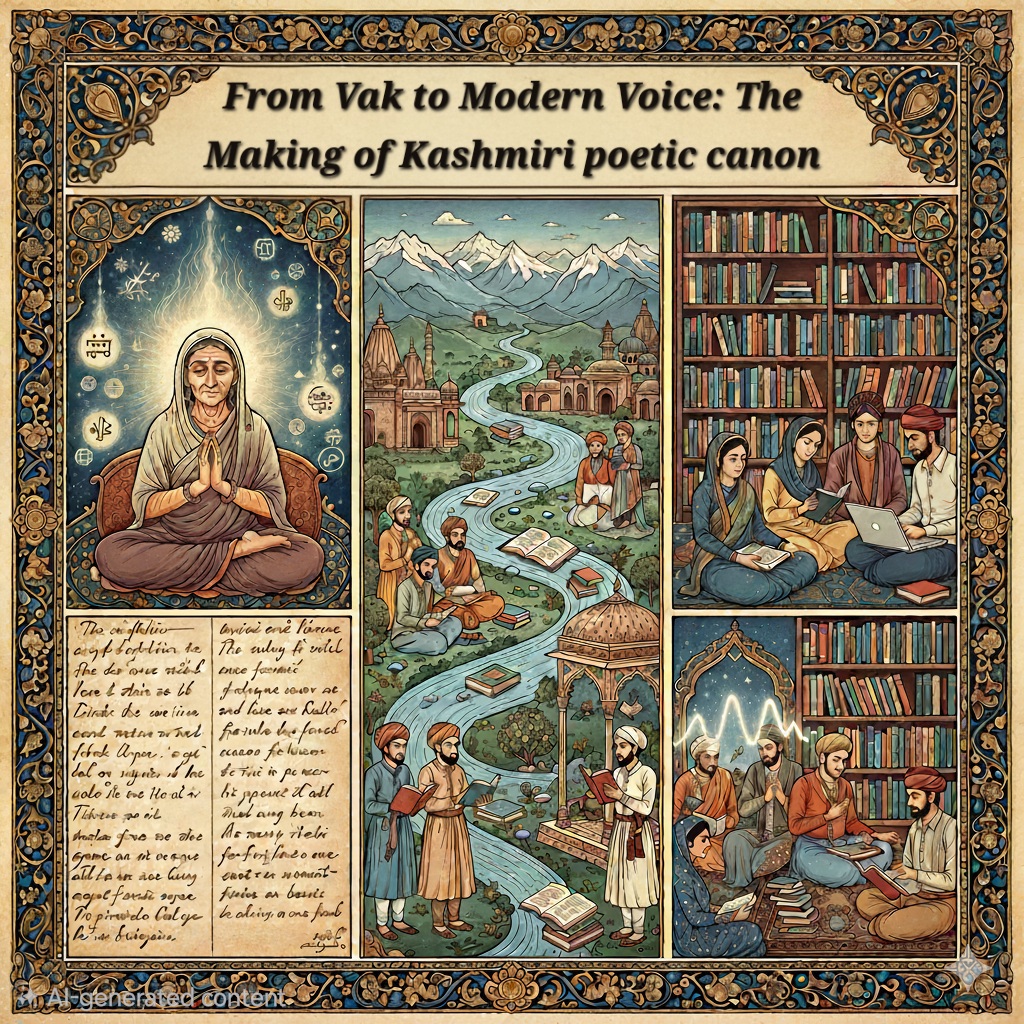
The Valley of Kashmir has a long history of cultural and linguistic pluralism, deeply reflected in its rich literary traditions as well as in its complex and eventful past.
From a linguistic perspective, Kashmir presents a unique case of sustained language contact. It is bordered by Sina (a Dardic language) to the north, Tibeto-Burman languages such as Balti and Ladakhi to the east, Pahari and Punjabi dialects to the west, and Dogri along with other Pahari varieties to the south. Alongside these regional languages, many non-native languages have historically functioned as markers of prestige and elite culture. Sanskrit and Persian initially fulfilled this role, followed later by Urdu, and more recently by English and Hindi. Each of these languages contributed additional layers to Kashmir’s already diverse linguistic and literary landscape.
The literary tradition of Kashmir can be approached from two distinct perspectives. It may be seen as a part of broader literary traditions of the subcontinent. From this comparative standpoint one may see elements of larger cultural continuum into the Kashmiri poetic and literary canon. On the other hand it may be seen as a cultural tradition in itself, a non comparative point of view, where it emerges as a unique and self contained body of writing. This perspective distinguishes it by a pronounced sense of “Kashmiriness” in its thematic and stylistic aspects.
While employing the second approach the development of Kashmiri literature should be examined in close relation to the socio cultural, historical and linguistic contexts of Kashmir valley. This approach deserves precedence because of the distinct linguistic charecteristics of Kashmiri and an essentially bicultural context in which Kashmiri language and its literature have evolved.
To start, with regard to the linguistic affiliation of Kashmiri language as a whole, the central debate hinges on whether the Aryan branch of the Indo-European family developed into three groups (Indo-Aryan, Dardic, and Iranian) or into only two groups (Indo-Aryan and Iranian).
Grierson supports the former view, while scholars such as Bloch, Morgenstierne, and Turner argue for the latter. Chatterji partially agrees with Grierson but does not fully endorse his conclusions. According to Grierson, the Dardic (or Piśāca) languages “are neither of Indian nor of Iranian origin, but belong to a third branch of the Aryan stock, which separated from the parent stem after the emergence of the Indian languages but before the Iranian languages had developed all their distinctive features.”
Scholars who support the two-branch model maintain that Indo-Aryan divided into two major groups: the Indian (or plains) group and the Dardic (or mountain) group. The Indian group includes languages such as Hindi and Punjabi, while the Dardic group comprises Kashmiri, Shina, and related languages. Traditionally, three subgroups are identified within the Dardic group: the Kafiri group, the Khowar group, and the Dard group.
Kashmiri occupies a particularly complex position within this classification system, which accounts for the longstanding controversy surrounding its affiliation. The language shares certain linguistic features with the Dardic languages and others with Indo-Aryan languages. It is for this reason that Grierson characterizes Kashmiri as a “mixed language” with two substrata.
Chatterji agrees with Grierson in identifying Kashmiri as a mixed language but does not accept that this necessarily places it within the Dardic group. He argues instead that several north-western Indo-Aryan languages, such as Lahnda and Sindhi, also display strong Dardic influences. From this perspective, Kashmiri may be understood as a north-western dialect of Indo-Aryan with deep and sustained Dardic influence. Consequently, Chatterji maintains that the question of Kashmiri’s precise linguistic affiliation “still remains an open one.”
Apart from the question of its affiliation one more peculiar characteristic of Kashmiri literature is the context of bi-culturality in which it developed. This bi-culturality resulted in development of two distinct and uniquely overlapping processes within it i.e Sanskritisation and Persianisation.
While Sanskritisation reflected Indian linguistic and literary traditions, Persianisation reflected a non-Indian, essentially West Asian impact on grammar, lexicon, and literal themes. These two themes provided Kashmiri two different stylistic and lexical registers through which literary expression could shape. However, there was an equally powerful and enduring process thriving in evolution of the body of Kashmiri literary development: the process of fusion or nativisation. This process absorbed elements from Persian and Sanskrit literature and re-articulated them within local indigenous framework. This resulted in a literary corpus that is not merely derivative, but distinctly local in its sensibility and expression.
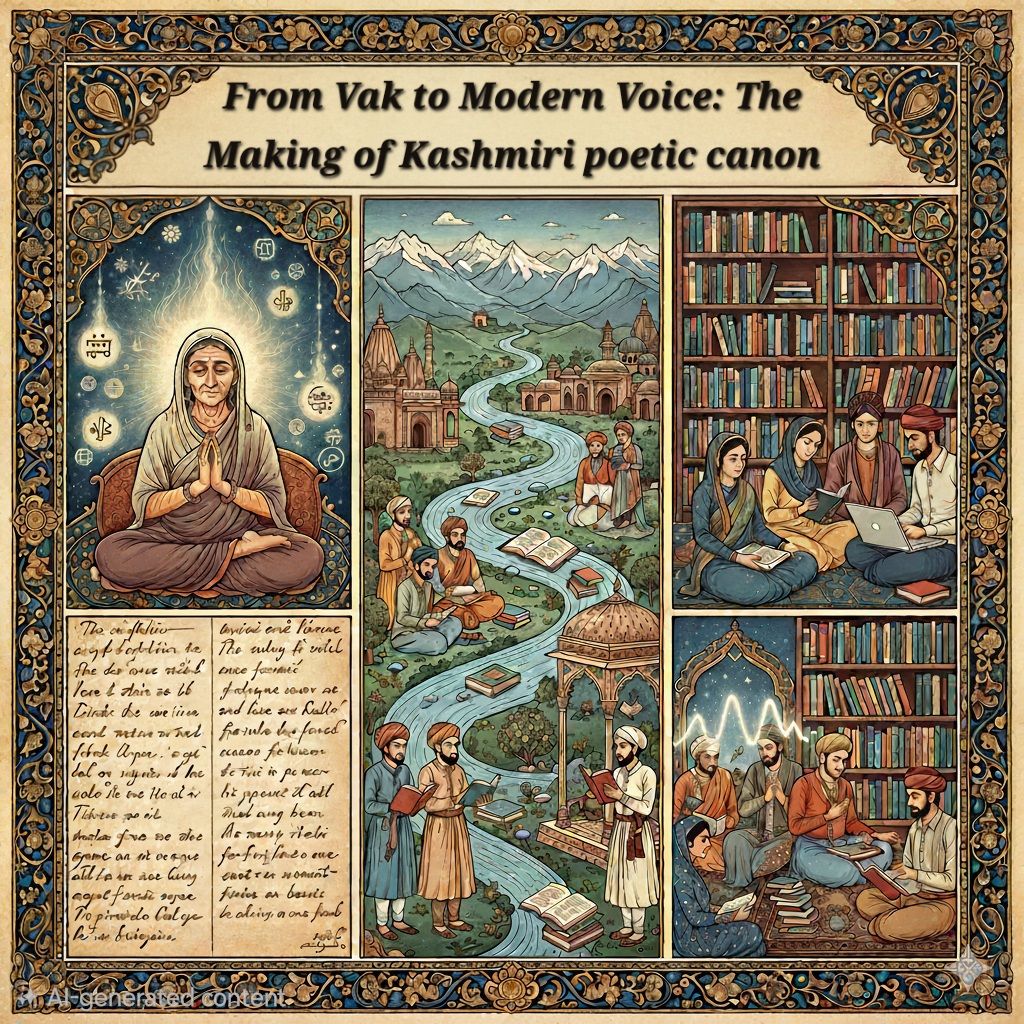
Beginnings
The development of Kashmiri literature can be divided into various phases with 13th century generally regarded as the beginning of it and 1300 to 1500 C.E marking the first phase of this process. According to S.K Chatterji it was the treatise on an esoteric Tantric sect entitled ‘Mahayana Prakasha‘ (Illumination of highest attainment) that was the first work that closely approximated Kashmiri language. Its author, Sitkantha deliberately chose to write in sarvahicara desi bhasa (language of commoners) instead of the language of the learned. While Grierson considers the text a work of 15th century, numerous other scholars concur to it being a work from at most 13 century. These divergences of opinion underscore the broader uncertainties surrounding the literary history of Kashmiri.
Other important specimen of Kashmiri literature is Avtara Bhatta’s ‘Banasura Katha‘ (The story of Banasura) which was composed around 1446 C.E. The text with its poetic qualities provides valuable linguistic evidence for the development of Kashmiri as a literary language. The only known manuscript of this work was obtained by Bühler and is presently preserved at the Bhandarkar Oriental Research Institute.
Mystical Oral Phase
The first specimens of authentic Kashmiri poetry were produced by a woman mystic, Lallesvari born around 1335 and largely known as Lall Ded. According to S.L Kaul, Lall occupies a position far greater than that of a poet alone, she is in “the succession of saints in Kashmir schooled in particular methods of meditation and concentration and forming a loose sort of order of their own and have regarded her as their patron”
The scholars of Sufism discern in her the elements of Sahajistic philosophy while Pandits scholars emphasize the Saivite content of her vaks (verses). Within the bicultural intellectual world she continues to be an integral part of Kashmiri literature. She is as central to its literary imagination as Shakespeare is to English, Hafiz is to Persian and Tulsidas is to Hindi. At the time, Kashmiri was often dismissed by elite historians and literati as Apabhramaa: non-literary, inferior, and largely inconsequential. She appealed to the poor and downtrodden peasants in the language they could understand and along with mystical themes took up issues of class, caste and social equality, challenging entrenched hierarchies and questioning ritualistic orthodoxy.
The numbers of Vak atrributed to her have never been more than 160. Grierson and Barnett have included 109 vaks in their well known work while in a recent work by J. L Kaul there are 138 Vaks.
Another saint-poet who is considered as a patron of Kashmiri poetry is Sheikh Nur-ud-Din. Lall Dead supposedly nursed him as a child and the two were spiritual aspirants. Two principal types of compositions are generally attributed to Nur-ud-Din: Shruk and bath bandi. Shruk is didactic in content and exhortative in tone often reflecting the transitoriness of life and its pleasure, bath bandi by contrast has a lyrical moral composition which is meant to be sung. The moral lessons of Nur-ud-Din have been collected in Rishinama and Nurnama and they occupy a singular position in Kashmiri literary history. His shrukh are uncompromising in their critique of greed, hypocrisy, and social injustice, while his bath-bandi displays a lyrical gentleness that lends itself naturally to song and communal memory; both continue to define the moral imagination of Kashmir.
Utha Som (Som Pandit), well-versed in Persian, Tibetan, Sanskrit and Pushtu languages, was another important poet of Budshah’s time and author of Zaina Tsareth (Zaina Charit) in Kashmiri. In this, as Shreevar says, he has narrated episodes of Budshah’s life in Kashmiri verse. The book was presented to the king.
Among the minor poets of this period were some of the disciples of Nur-ud-Din. Baba Nasr-ud-din, called Sultan-i-Swokhan (Master Poet), made his master’s personality the main theme of his compositions. Other poets of this era are Sahab Kaul, Mirza Akmal Din beg Khan Badakshi, Shang Bibi etc.
Mirza Akmal Din Belonged to a family of immigrants from Badakshan and held a responsible position in the Mughal administration. His two books of poetry in Persian are Makhbar-ul-Asraar and Bahar-ul-Irfaan, a masnavi explaining the significance of arafaat, the vigil on the eve of Id. Juma Bibi, a disciple of Badakshi was a confectioner’s wife in Navhatta in Srinagar who wrote both mystical and love lyrics. She is remembered mostly for her marsiyya on the death of her master. Shaam Bibi, a woman disciple of Nund Rishi, composed an elegy in memory of her master Baba Nasr in the fifteenth century. Written concurrently with the early development of the genre, this composition is regarded by many scholars as the earliest Kashmiri elegy dedicated to a specific individual. Literary formations up to this period represent the incipient phase in the evolution of the Kashmiri elegy, locally known as waan, a form that had not yet acquired a fixed structure or formal conventions. The first elegies written in Kashmiri to commemorate Husyan’s martyrdom also date from the same period in works composed between the 15th and 16th centuries. These include marsiya written by two poets from the Musavi family Qasim bin Yusuf Din Shah and his nephew Hakim Din Shah in and around 1409-1446 C.E during the Shahmiri Sultanate.
Era of synthesis
The years 1500-1700 in Kashmir were marked by rapid change, turmoil and instability. Even though the process of Persianization was dominant the Sanskrit Saivite tradition continued in latent form. Persian attained the status of court language and provided model for literary and linguistic standards. The people’s own language continued to be low in prestige with no status in administration or education. For scholars and creative writers of the period, intellectual and literary aspiration lay largely in mastering Persian and Sanskrit. Nevertheless, despite this marginalization of Kashmiri, several writers achieved remarkable poetic distinction in the language. The most famous among them being Habba Khatun, Khawaja Habibullah Nowsheheri, Rupa Bhavani, Prakash Ram and Arnimal.
Habba Khatun is often considered as the most musical lyricist of Kashmir, having brought the lol lyrical tradition to its higest form of perfection. The poetry, it seems, came naturally to Habba right from her childhood and she employed the native diction for it with great spontaneity and emotional depth. Legend recounts that she was unhappily married to a simple village youth before encountering Prince Yusuf Shah Chak. The two fell deeply in love, after which she separated from her first husband and became Yusuf Shah’s consort. However, Yusuf Shah eventually fell victim to political intrigue and was imprisoned in Bihar. This forced separation and the social humiliation that followed proved emotionally devastating for Habba Khatun and lent her lyrics their enduring poignancy. In the last days she sang plaintive songs in Gurez. Her poetry remains a great example of lol tradition of Kashmir, embodying its intensity, musicality and emotional resonance. Habba was innovative in several other ways, one being the introduction of rast raq in Kashmir.
Khawaja Habibullah Naushahri (1555-1617 C.E) carried forward the vak tradition of Lall Ded. Naushahri’s vaks had longer lines and measured, contemplative rhythm. While his diction was simple and rooted primarily in native Kashmiri, his imagery reveals a clear influence of traditional Persian poetic conventions.
The period of the Chak dynasty is widely acknowledged as the Golden Age of Kashmiri marsiya, marked by significant formal consolidation and thematic expansion of the elegiac tradition.
The life of Rupa Bhavani was bears close resemblance to Lall Ded and Kashmiri Pandits, especially the Dhars, have given her a quasi-divine status. The writings of Rupa Bhavani are also in Vak form however, her vakhs are markedly more Sanskritized and generally less evocative in imagery when compared to those of Lall Ded. Her Vaks reveal influence of both Saivism and Islamic Sufism. Her Vaks are difficult to understand for two reasons: they articulate esoteric mystical experiences, and they employ an extremely dense and obscure language. In certain verses, the diction is almost entirely Sanskritized, with only minimal presence of Kashmiri vocabulary.
These reasons are responsible for her limited reception within the wider Kashmiri literary tradition. Rupa Bhavani remained essentially a part of the Kashmiri Pandit religious and devotional tradition rather than becoming an integral figure in popular Kashmiri literary consciousness
Arnimal was married to a Persian scholar Bhavani Das Kachru, author of Bahr-i-Tavil who is said to have mistreated and eventually deserted her. She sought solaced for her hurt feelings by taking to the spinning wheel. She sang lyrics of love, of separation, frustration and complaint; transforming personal suffering into poetic expression. Her lols possess fresh imagery and a finely tuned phonaesthetic tenor with striking simplicity of expression. All these render her writings with an emotional cadence that secure her place among the finest lyric voices of Kashmir.
Persianate Classical Phase
By 16th century, Persian was already accepted as the language of system as well as that of education and administration. The Kashmiri literature of this era (1700-1900) is heavily influenced by Persian metaphor. However, Sankritised Kashmiri too remained in vogue. In Persian influenced Kashmiri literature the Persian legends like Yusuf, Zulaikha, Laila, Majnun, Sohrab, Rustum became sources of inspiration. Even the models for comparison became Persianized: Mahmud Gami of Shahbad was called Nizami of Kashmir and Wahab Pare became Firdausi. This period was productive mainly of two types of Kashmiri poetry: Sufi and Bhakti.
According to Trilok Nath Raina, it was Mir Abdullah Baihaqi who adopted the tradition of masnawi in Kashmiri eg in Kashir Akeeda and Waquaya. However, the tradition of masnawi was popularised by Mahmud Gami. There are nine masnawis attributed to him i.e., Laila Majnün, Yusuf Zulaikha, Shirin-Khusrau, Harun Rashid, Malmüd Gaznavi, Sheikh Sanan, Sheikh Mansor, Pahalnama, and Yäkhayat. He also wrote over a hundred poems and ghazals. He was known as Mard-e-ustaad by his contemporaries. While Mahmud Gami rendered well-known Persian epic and romantic themes into Kashmiri, Waliullāh Mattu took a different approach by choosing a native story Himal and presenting it in vernacular language, thereby rooting the masnawi tradition in local culture and imagination. Rasul Mir’s poetry is limited to sixty seven poems but his popularity is not surprising since his diction is close to common speech. His poetry presents a unique specimen of great crafsmanship in both the sound and sense, making him integral part of Kashmiri oral tradition. The story of Gulrez by Maqbul Shah Kralwari based on a Persian work by same name by Ziya-ud-Din Naksahbi is an important work of Kashmiri masnawi canon. Maqbul has nativized the story in his description of the valley. In addition to Gulrez other masnawis composed by him include, Pirnama, Qissa–i–Hazrat Shabir and Greesnama.
This tradition was followed by several other poets of this era like Shah Gafir, Soche Kral, Abdul Ahad Nazim, Shams Faqir, Abdul Wahab Pare, Wahab Khar, Ahmad Batwari and Abdul Ahad Nadim.
During this time another Kashmir literary tradition that developed was that of Bhakti poets that followed the Rama and Krishna canon of Hindu mythology and wrote episodes of Ramayana and Mahabharta. Among the poets of this tradition, three figures stand out: Parmananda, Lachman Raina, and Prakash Ram. Their writings exemplify the devotional spirit of Bhakti while adapting classical epic material to the linguistic and cultural context of Kashmir.
Pandit Nand Ram known as Parmananda- learnt both Persian and Sanskrit very early as a boy. He was introduced to scriptural Hinduism through a family priest. His poetry is divided into various groups: dinakrandama: litanies addressed to Hindu gods, yogabhyasa: poems on yogic practices and third group which contains lila poems in which he gives free expression to his love of God in the tradition of Radha Krishna. The fourth group contains didactic poems and last one poems thar deal with philosophical and vedantic topics. Lachman Raina continued in tradition of his precept and composed Samnama, Omnama, Nala Damyanti and many bhajans. Prakash Ram wrote an epic based on Valmiki Ramayna. The language he employs is very less sanskritized, a village dialect of Kashmiri is mostly used. Zinda Kaul considers it was the first razmia masnavi in Kashmiri.
During the late eighteenth and throughout the nineteenth century CE, a new form of marsiya writing in Kashmiri emerged, marking a major evolutionary phase in the genre. Literary critics describe this period as the age of classical marsiya or muqam bandh marsiya. The marsiya that developed during this era is structured around four fixed stations (muqam), which determine the thematic progression of the poem. Each muqam in turn constitutes a stanza (chyir / چھیر), characterized by a parallel internal structure and formal symmetry. Husayn Mir, popularly known as Hussi Boii, played a crucial role in popularizing the new form of Kashmiri marsiya among the urban elite of Srinagar. He also introduced significant innovations in the internal structure of the marsiya. Furthermore, he familiarized the Mulla family poets in Srinagar, who had previously been primarily engaged in composing Persian verse, with this emerging Kashmiri marsiya form.
The earliest composition of Kashmiri marsiya by the Mulla family include Mulla Hakim Muhammad Azim Mulla Munshi Muhammad Yusuf and Mulla Munshi Shah Muhammad. Hakim Azim and Munshi Yusuf played pivotal roles in enhancing the poetic sophistication of the marsiya, enabling it to transcend the conventional constraints of a purely elegiac form.Over the subsequent two generations, the Mulla family produced a continuous lineage of notable marsiya writers.
Reformist phase
The modern period in the development of Kashmiri started from 20th century. The attitude of inferiority towards Kashmiri in this era was still noticeable but its markedness had reduced.
During the early twentieth century three types of poetry were written. The frst continued in the earlier mystical tradition, developing into a humanistic strain and displaying a marked yearning for what may be termed ‘inner peace’ and harmony. This further development was partly the result of the post-World War II upheavals and the resultant human suffering, felt both in the Western and non-Western worlds. The post-partition mobilization on the borders of Kashmir brought the whole drama of conflict nearer home. Second, in poetry, the strain of Kashmiri identity became marked: attempts at self-discovery as a viable nation and self introspection were initiated. This type of poetry displays an assessment of “Kashmiriness,” a contemplation about the state of Kashmiris, as people and as a nation. It is essentially a poetry of introspection, challenge, reawakening, and nationalism. The main carriers of this message of awakening are Mahjur and Azad. In their poetry, for the first time, we find a bold message, yearning for self-realization, and pride in native traditions and language. Third, though this was a period of innovations, in stylistic terms, the lol tradition continued, and Mahjur made a very impressive and lasting contribution to it. Finally, new ideas, both political and social, came from other parts of world, especially through the Progressive Writers’ Association, which was already well established in Kashmir.
Ghulam Ahmad Mahjur is regarded as the most important figure in the revival of Kashmiri language and culture. He played a decisive role in transforming Kashmiri poetry into a modern, respected, and popular literary medium. Born in the village of Mitragam near Srinagar, Mahjur initially wrote in Persian and Urdu, as was customary among Kashmiri poets of his time, but later consciously turned to Kashmiri. He becoming the first modern poet to elevate it to national and international notice, even attracting the admiration of Rabindranath Tagore. A humble and shy man who spent most of his life as a patwari, his close contact with rural Kashmir deeply shaped his poetic sensibility and rooted his work in the lives of ordinary people. Mahjür introduced a new diction and technique, expanded the thematic scope of Kashmiri poetry, and blended innovation with tradition, particularly enriching the lol genre while reworking local myths and legends with remarkable skill. His poetry secularized Kashmiri verse and expressed subtle nationalism and cultural pride through accessible imagery that resonated across religious and social lines. The educated elites initially viewed him with skepticism due to their preference for Urdu and English. Influenced by broader social and political currents, including ideas circulating through the Progressive Writers’ Movement, Mahjur emerged as a foundational architect of Kashmiri literary modernism, providing at a crucial historical moment exactly the poetic voice and cultural confidence that Kashmiri society needed.
Mahjur’s senior contemporary, Zinda Kaul Masterji acquired the title masterji from his disciples. Zinda Kaul composed in Persian, Urdu and Hindi. Before his restirent he had written only one lyric in Kashmirii. However, in 1942 he recited Panin Kath at SP college. His poem Sumran was published in 1944 and it earned him a permanent position as an important Kashmiri poet. In tone and spirit, his poems possess a distinctly therapeutic quality, resembling the meditative musings of a bhakta and finding expression through forms such as ghazals, lila, bhajans, and rubaiyat. His poetic voice differed markedly from that of Mahjur, Azad and the dominant literary currents of the period. In both tone and thematic emphasis, he remained firmly rooted in earlier Kashmiri poetic traditions, particularly those associated with Paramananda. He never fully relinquished his attachment to mystic expression.
Abdul Ahad Azad was the younger contemporary of Mahjur and Zinda Kaul. He blazed the trail of revolution and social change in Kashmiri poetry. He expanded the thematic and ideological horizons of Kashmiri poetry, as in Inqalab (“Revolution”) or Dariyav (“The River”). While themes of social transformation and change had Azad handled them on a larger humanistic and universal basis, shaped by his commitment to scientific humanism. As a stylistic experiment, his Dariyav is considered as “one of the best poems so far written in Kashmiri.” Azad’s poetic career unfolded in three distinct phases which are coincident with the nom de plume he adopted in each phase. The first included his rendition of love lyrics and devotional poems which write under the name of ‘Ahad’ (Unique), in second he wrote poetry on nature under name Janbaz (Daredev), the examples of poetry during this phase are Arival (The Wild Rose) and Vanicvar (Pine of the forest) and finally ‘Azad’ (Free). By 1942, his close association with P. N. Bazaz and socialist circles further deepened his ideological clarity. According to Bazaz, “While Mahjur was moving like a shuttle-cock between Religious Humanism and Modernism, Azad courageously preached Scientific Humanism.” The restlessness of an anarchist is clearly expressed in the poetry of Azad such as his well known poem Dariyav. Azad introduced revolutionary themes and spirit in Kashmiri poetry.
There is no doubt that Mahjur and Azad, and to a lesser degree Masterji, dominated this period of Kashmiri poetry. But other poets also contributed, giving a new direction for the almost moribund Kashmiri literature. Among such poets one must mention Mir Ghulam Hasan Beg Arif, Ahad Zargar, Mir Ghulãm Rasül Nazki, Dinanath Wali Almast, and Ghulâm Ahmad Fazil. They played important roles in steering Kashmiri literature away from stagnation and toward renewal.
Rennaisance
The political events that unfolded in Kashmir in the aftermath of partition resulted in mobilisation of Kashmiri poets, writers and artists. The establishment of Radio Kashmir in 1948 played a vital role in revival of popular interest in the indigenous forms of poetry, music song and prose, providing a platform for artistic expression. It was at this time that Dina Nath Nadim rose to prominence and remained at the forefront of Kashmiri literary scene ever since. Widely regarded as one of the most innovative and sensitive Kashmiri writer; it was due to his deep and profound impact on various genres of Kashmiri literature, his influence on his contemporaries and on younger writers, and his formal experimentation and thematic extention that his period of Kashmiri literature is often identified as the Nadim era, or the age of Nadim.” Nadim passed through numerous stages and in each of them engaged in distinct thematic and stylistic experiments. He wrote his first Kashmiri poem in 1942 on “Moj Kashir” at a time when Kashmir was passing through a critical political stage with the mass movement of ‘Quit Kashmir’ challenging the Dogra dynasty. Nadim wrote patriotic poems like Soth (Spring), Grav (Complaint) and Arivali Prarakhma. In 1951, Nadim introduced blank verse in Bi Gavi ne Az ( I l not sing today). Nadim continued to be politically active, political poems had a socialist background that did not sound like sloganeering. In 1953, he wrote the first opera in Kashmiri Bombur te Yemberzel (Bee and Narcissus). Nadim kept on experimenting with Petrarchan and Shakespearean conventions in which we find selective diction, suggestive imagery and delicate linguistic craftsmanship.
After trying various new forms such as free verse, the sonnet, Japanese Haiku style etc, in 1960s Nadim returned back to native traditional which had reached its peak in Lalla.
Nadim’s dextrity and stylistic innovations make him one if the greatest in Kashmiri literature who marches over many of his predecessors and contemporaries.
This era paved ways for many other poets like Amin Kamil, Rahman Rahi and Zareef Ahmad Zareef. Kamil excelled in Ghazals, he introduced realism and modern sensibility in Ghazal and nativised it in diction and symbolism. One finds novelty in all the fileds that Kamil experimented with i.e Poems, Short story, poetry, drama, criticism and novel.
The poetry of Rahman Rahi occupies a central and transformative place in modern Kashmiri literature, marked by its philosophical depth, linguistic sophistication, and profound engagement with history and human experience. Early in his life he came under the influence of leftist and progressive political and literary ideologies. During the early part of his life he wrote mainly in Urdu. It was in 1950s that he began writing in Kashmiri. Sanivin Saz (The penetrating notes) included many ghazals and they had an intrinsic merit with hardly any weak line or metaphor; in line with what was called ‘progressive writing’.
Drawing creatively on classical Kashmiri forms such as the vakh and shrukh while infusing them with modern existential and socio-political concerns, Rahi bridges tradition and modernity with remarkable intellectual rigor. The titles of some of his poems like Yeli Rav Khasi subhuk prav travaan (When morning sun appears disseminating its rays) are classic examples of progressive style diction and metaphor.
His poetry reflects a deep awareness of Kashmir’s cultural memory, collective suffering, and moral dilemmas, often employing dense symbolism, myth, and metaphor to explore themes of identity, alienation, time, and continuity. It is evident that between 1950 to 55 he was deeply influenced by Nadim. However, the clear break from progressive phase came in 1970 when he wrote Yakrar (Confession); where Rahi metamorphosed from a progressive materialist to an existentialist as we see in Sadah (A plea) and Baas (Feeling)
Unlike the overt romanticism of earlier poets or the direct revolutionary rhetoric of some contemporaries, Rahi’s verse is contemplative and layered, demanding an active, thoughtful reader. His mastery of language and form from various literary quarters, combined with his ability to universalize Kashmiri experience without diluting its specificity, earned him recognition as one of the most intellectually accomplished poets of Kashmir. He drew non Western influences from modern Persian writers like Nima Yushij, Faurugh Farrukhzad. The western influences came from Eliot, Manly Hopkins and others.
The intellectualisation of style in Rahi’s poetry, his adaptation of symbols from Greek, Islamic and Indian mythology established him as a defining voice of its modern poetic consciousness. Just like Rahi, Firaq served his apprenticeship under progressive and marxist influences. In 1962 he published a join collection with Rahi called Yim San Alav (Our calls). Firaq contributed to translating into Kashmiri the poems of Tennyson, Keats and Elliot. He concentrated on nature and romantic lyrics with descriptive and alluring lyrical quality. Moti Lal Saqi began life as a Government employee in the Department of Agricultural Development where, there being no work as such, he found bundles of time for study, a blessing for which he does express his gratitude. His subsequent postings were Radio Kashmir and J&K Cultural Academy.
The Muse blessed him early in life, and he published his first collection of poems Modury Khaab (Sweet Dreams) in 1968. He grew up to be essentially a poet of the nazam and the rubai. Though he was influenced by the stalwarts of the progressive movement like Nadim, whom he admired enormously and from whom he learnt a lot about the art of poetry, he was never a poet of slogans and revolution.
On the contrary, he chose topics like gabirachh (shepherd), Yaavun (youth), Obur (cloud) and other down-to-earth themes. His language is the pure and simple language of the soil, far removed from the sophistication which poets aim at for ‘effective communication’. He never believed in literary extravaganza. His simplicity summed up his entire personality.
The other poets of this era include Ghulam Rasul Santosh, Makhan Lal Mahav, Muzaffar Azim, Mohan Nirash, Ghulam Nabi Khayal, Moti Lal Naz, Chaman Lal Chaman, Makhan Lal Bekas, Ghulam Ahmad Gash, Ghulam Ahmad Ajir, Rafeeque Ahmad Raz.
Post classical phase
At present there are numerous poetic trends and no dominant influence, making the literary scene much different from the organized one which existed up to the 1960’s.
Ghulam Mohammad Gamgeen’s Brum, Mishal Sultanpuri’s Vany Ditymas, and Farooq Nazki’s Kob Kul present the picture of a world gone haywire. And Mohammad Ayub Betaab has that same story to say in Duhuly Khaab.
Ghulam Hassan Taskeen in Nazam laments the pallor of aarawal (the yellow rose). Rahim Rahbar in Zaal talks of the crawling snakes and of how the spider is the victim of his own devices, caught in the web he himself has woven. Mirza Arif asks the Harduk gwolaab (autumn rose) why he should enter a garden where butterflies and bumble bees are no longer the same friendly types, where water lies frozen hard, where the bulbul has bloodshot eyes. Ahmad Zareef in Boonü laments the merciless felling of the glorious chenars. Rasul Pompur in Vuni ti Ganeemath says it is a miracle that we are still together and is afraid the situation may not last long, for anything might happen tomorrow.
The same is the theme of Raghu Nath Kastoor’s Sonchi Manza Neri Kyaah. He finds the howling storm everywhere, with no sign of abating.
There is a fugitive hope, however, as can be seen in Rahi. This fugitive hope that good will prevail in the end is also expressed by Ranjoor Kashmiri, Muzaffar Azim and Rafiq Raaz.
Zareef Ahmad Zareef’s poetry stands at the intersection of satire, social critique and cultural memory in modern Kashmiri literature, and is central to understanding contemporary Kashmiri sensibility. Best known for his sharp satirical verse, collected notably in Taaran Garee and Buzeiy ne kaensi zaeree, he exposes hypocrisy, corruption, and cultural pretensions with biting humour. He writes in an accessible, idiomatic Kashmiri, drawing heavily on oral speech, proverb, street idiom and folk humour, which makes his verse immediately communicative to common listeners
With continuously changing and reforming social and political circumstances in Kashmir, new subjectivities and sensitivities keep emerging. These find expression in unique forms of poetic articulation. The canon of Kashmiri poetry is as living as Kashmir itself and keeps constantly reshaping, revising, and renewing its contours.


 The K-Blog
Leave a reply to Khawar Cancel reply