
Khawar Khan Achakzai
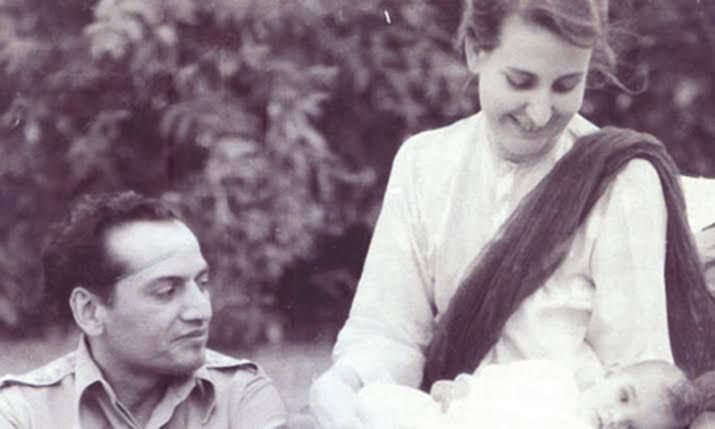
Faiz Ahmad Faiz was not only one of the greatest poets of Urdu language- he was the language unto himself. He had a rare distinction of being an equally renowned political activist, a revolutionary and an outspoken orator who would portray political themes in his poetry in arduous ways. In his verse, politics did not shout, it smouldered, wrapped in beauty,
arriving like love, and leaving like a wound.
His repeated incarcerations have been situated within fraught dialectic between dissent and state formation in post 1947 Pakistan. His left wing politics and what was often deemed as his castigation of entrenched politcal authority in Pakistan, rendered him not merely a poet of resistance but a subject of it. He would lament in his poem Subh-e-Azadi, “hame intizar tha jiska ye woh sahar to nahi…”, voicing his disillusionment with the promises of independence, the lines articulating an ontological rupture between expectation and reality. What was supposed to fuction as a teleological endpoint of liberation becomes an unstable signifier. The poem suggestins that the journey from colonial subjugation to sovereignity may reproduce, rather than resolve the larcenous structures of domination.
Faiz was nominated for a Nobel Peace price twice and received International Lenin Peace price in 1962.
From his love for the land, his marriage in Srinagar and his association with Kashmiri leadership, Faiz’s Kashmir connection ran deep. Kashmir for Faiz was presence: intimate, unresolved and deeply inscribed within his emotional world.
Faiz’s marriage to his beloved Allys George (who would take the name Allys Faiz) was performed in Srinagar in October 1941 and was solemnised by Sheikh Abdullah. The cermony wove Faiz more deeply into the moral and emotional landscape of Kashmir.
Alys would later recount her marriage day with a tenderness edged in quiet humour.. She would recollect the memories of “Faiz Sahab” that how she had asked Faiz if he bought her a ring and he said he did. He said that he had borrowed money from Mian Iftikharuddin (editor-in-chief of Pakistan Times) and joked that he would not be paying him back.
In The Kashmir Dispute 1947–2012, the historian A. G. Noorani notes that Kashmir’s then “most popular political leader,” Sheikh Abdullah, solemnised the nikah of Faiz Ahmad Faiz in Srinagar, at Pari Mahal, when the poet married the young Englishwoman Alys Faiz.
Bilqees Taseer, sister of Alys Faiz and an eyewitness to the ceremony, offers a quiet but important correction. In her book Kashmir of Sheikh Abdullah, she notes that the nikah of Faiz Ahmad Faiz was solemnised not at Pari Mahal, but at the Old Maharani’s House in Srinagar.
This intimate convergence of love, politics, and place finds echo again in the book Love and Revolution, where his grandson Ali Madeeh Hashmi retraces the same moment, as if to affirm that, for Faiz, even the most personal of unions carried the quiet imprint of history.
Sheikh posed the marriage questions in three different languages: English, Urdu and Kashmiri. “The nikahnama was signed by G.M.Sadiq, Bakshi Ghulam Mohammed [both former Prime Ministers of Jammu and Kashmir] and Dr. Noor Husain as witnesses,” A G Noorani writes.
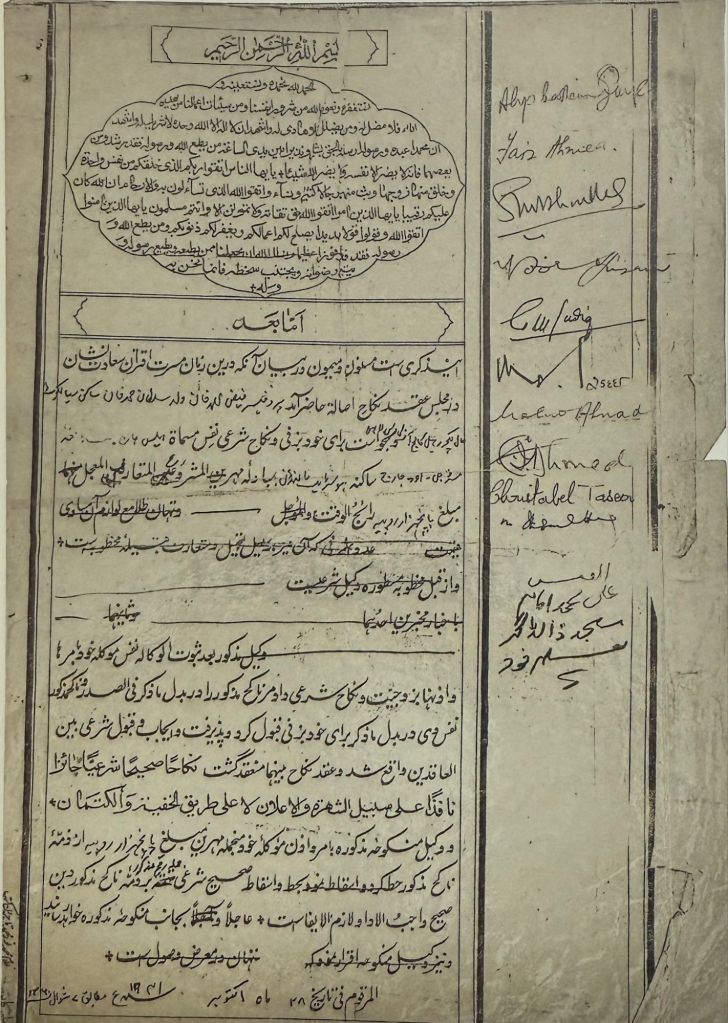
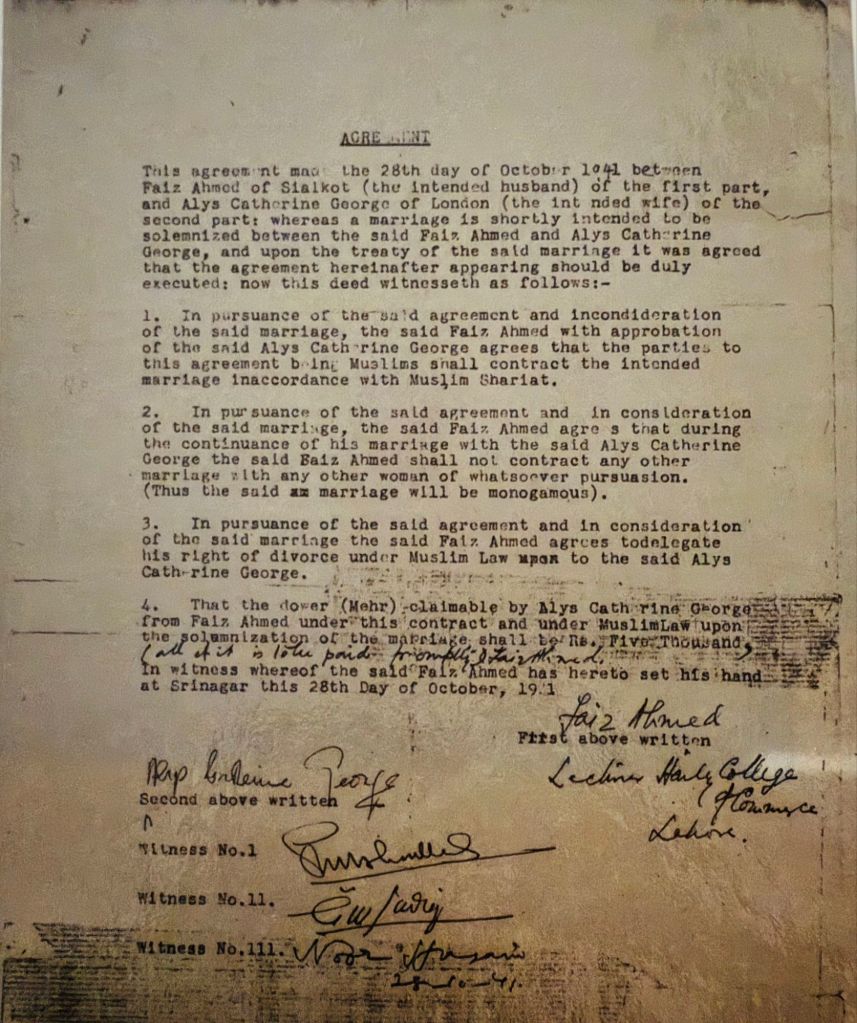
The official marriage agreement between Faiz Ahmad Faiz and Allys George reached at the dower (mehr) of 5000 rupees paid to Allys by Faiz, in accordance with the Muslim law.
The nikah cermony was followed by a small gathering and a mushaira. At the time of her marriage, Alys was given a Muslim name – Kulsoom, a name that would echo, again and again,
through the inner music of Faiz Ahmad Faiz’s poetry.
The ceremony was followed by an informal party which was attended by many prolific poets and writers like Josh and Majaaz.
Faiz and Alys’s Nikahnama, the marriage contract, was modelled after that of Christobel (Bilqees) and Dr Taseer, which had been drafted by Allama Iqbal. It very was progressive for that time, modelled in spirit by Allama Iqbal’s reformist imagination, it granted the wife full right of divorce, bound the husband to monogamy, and left all other conditions open, not to custom, but to negotiation.
The debate on these conditions later lead to enaction of Muslim Family Ordinance Pakistan which is followed unto this day.
Kashmir in those days had become a crucible of radical thought. Srinagar was a seat of communist activities and famous marxists like B.P.L Bedi, Freda Bedi, Rajbhans Krishan Sharma etc would frequently visit and navigate through the landscape.
A branch of the Communist Party of India was established in Srinagar in 1942, apparently to strengthen the Allied war effort. In September 1942, Fazal Elahi Qurban, a well-known Communist from Lahore convened an anti-Fascist school in a house boat in Srinagar, an unlikely classroom, afloat on still waters,
teaching resistance in a world at war.
GM Bakshi and Mohd Sadiq of National Conference appear to have visited the school and encouraged the movement. It is within this charged political moment, liks many historiams believe, Faiz and Allys chose Kashmir as a place for their union. Both were participants in that communist ideological tide and what could have been a place better to render it into a spritual unison than Kashmir itself.
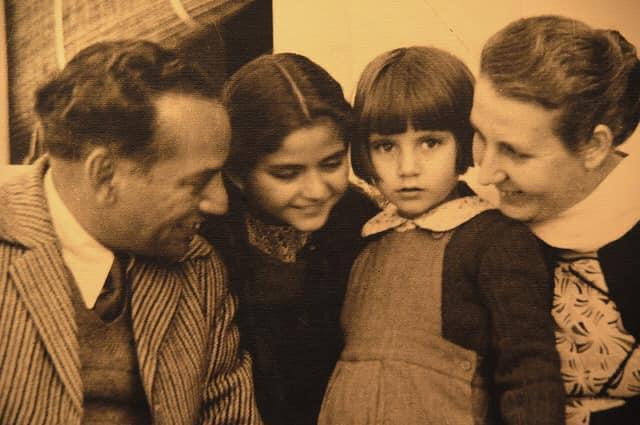
Alys’s sister Christobel had married Dr M.D Taseer, a Marxist and the then principal of S.P college in Srinagar. These bonds were both personal and ideological and relationships were not only of affection but also of shared political beliefs and intellectual kinship.
In 1947, the tumultuous year when Partition took place, Alys would write from Srinagar to Faiz who was in Lahore.
In one of his replies, Faiz laments the horrors of partition, “it seemed so unreal and far away as long as I was in Srinagar, but it has all come back and is far, far worse than anything I had feared and imagined. From early morning till late evening one hears nothing but tales of horror and even though one ties shut one’s mind and one’s ears tight against them there is no escape from the horror or tragedy that surrounds one from every side”
Renowned music composer Arshad Mahmud, who was also a student of Faiz, and composed his poems into somgs, performed by Tina Sani and Nayyara Noor, revealed that ‘Bol ke lab azaad hain tere’ Faiz had written for Sheikh Abdullah.
In his book, playwrighter and broadcaster Agha Nasir also mentions the friendship between Faiz and Sheikh Abdullah, corroborating the possible dedication of this poem to Sheikh.
In an interview with Kashmiri journalist Shamim Ah. Shamim, Faiz was asked what he thought was the best solution for Kashmir.
Faiz’s answer: “The best solution for Kashmir is that both countries should leave Kashmir alone and, as a self-governing State, Kashmir should establish friendly relations with both countries. Eventually this is what will happen; but after suffering much harm and damage. People like you on both sides should jointly propose such a proposal.”
The said interview was first published in ‘Aina’ and reprinted in the Srinagar based Urdu weekly ‘Chattan’ on 18 April 2011, and can be found in Shameem’s collection of articles called ‘Sheeraza‘.
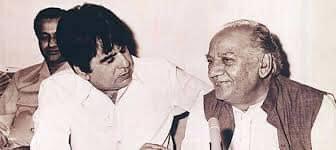
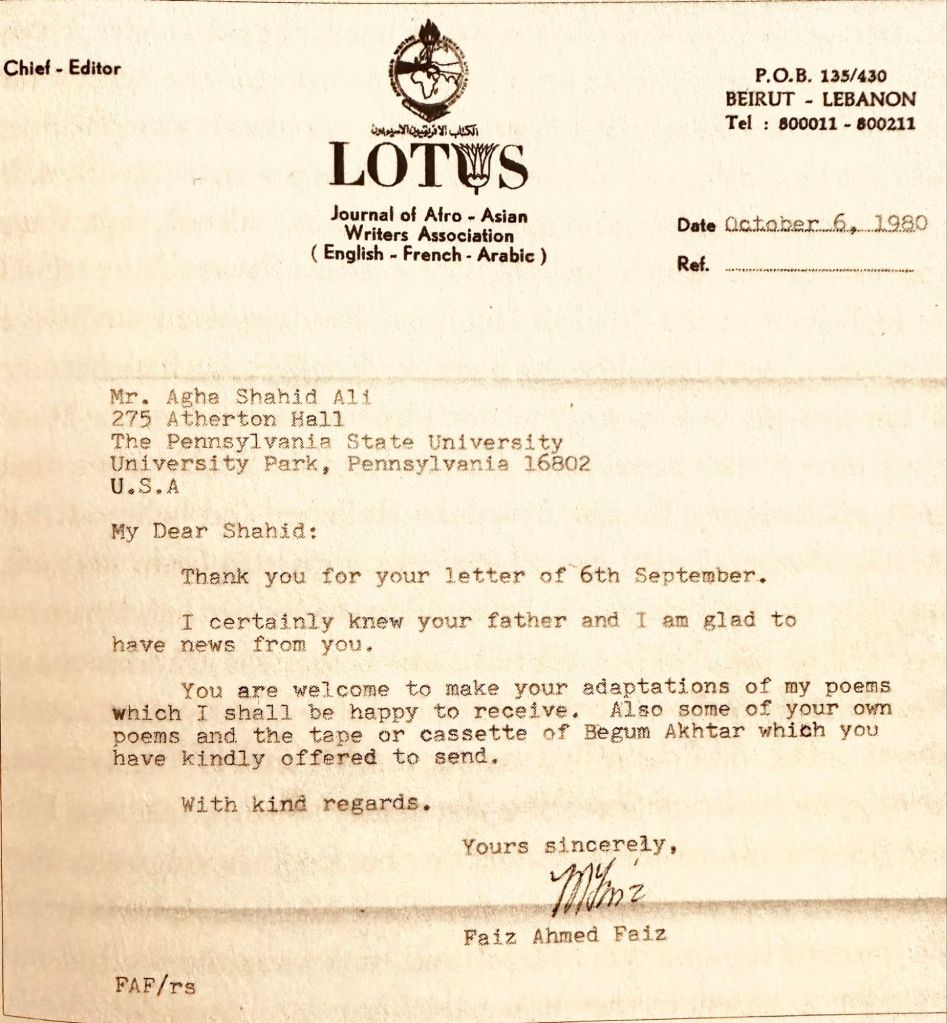
Agha Shahid Ali had once sought permission to translate the poetry of Faiz Ahmad Faiz. Faiz granted his request after his return to Lahore from Beirut.
Ali would later remember this moment in his tribute, Homage to Faiz Ahmad Faiz. The act of translation itself were not merely literary, but a quiet passing of voice across geographies,
from one exile to another.
Ali translated selected poems of Faiz in The Rebel’s Silhouette. They had met once before, at Ali’s own house when he was still a child. Their mutual love of Begum Akhtar became a fond memory between the two.
Ali delivered multiple lectures on Faiz’s poetry and activism after Faiz passed away.
Ali recalls this exchange in his book The Half-Inch Himalayas:
“Twenty days before your death, you finally wrote, this time from Lahore, that after the sack of Beirut you had no address. I had gone from poem to poem and found you once, terribly alone, speaking to yourself.
‘Bolt your doors, sad heart! Put out the candles, break all cups of wine. No one, now, no one will ever return.”
 The K-Blog
Leave a comment