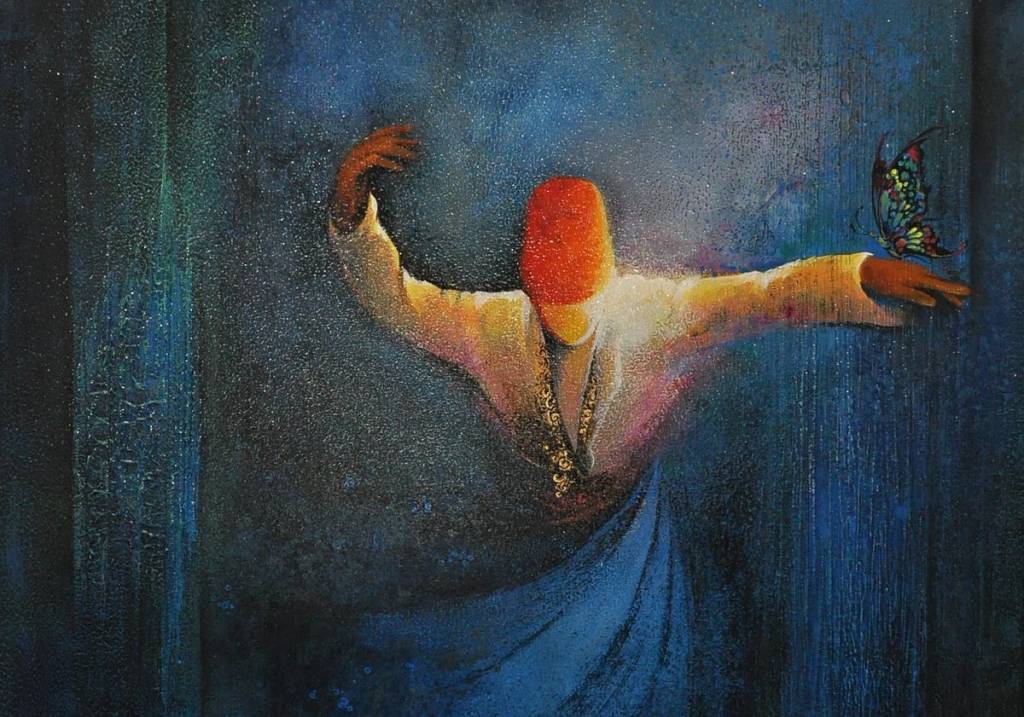
The lover repeats his tale unweariedly: how should a fish be satisfied with (mere) indication (so as to refrain) from the limpid waters?
Love is the greatest mystery of life that defies all analysis and shames all questions. Like life, it is indescribable and an attempt to define it is as baffling as defining life itself. Questions demand boundaries: Love refuses them, queries seek limits: Love finds its way where limits dissolve, mind draws circles and Love, unapologetically, steps outside. It is irrational yet truthful, transient yet eternal, personal yet universal.
He (the lover), from that ancient grief, was speaking a hundred words in complaint, saying,
“I have not spoken a word.”
There was a fire in him: he did not know what it was, but on account of its heat he was weeping like a candle.
Rumi understood this indescribability of experience, but like a longing reed (ney) he philosophised it. The reed that is cut from the reed-bed; its song is born of separation. What it produces is not an explanation of love, but a cry shaped into sound. The sound that is not entirely its own but of the wind (of longing) and neither entirely of the wind but of its own emptied being.
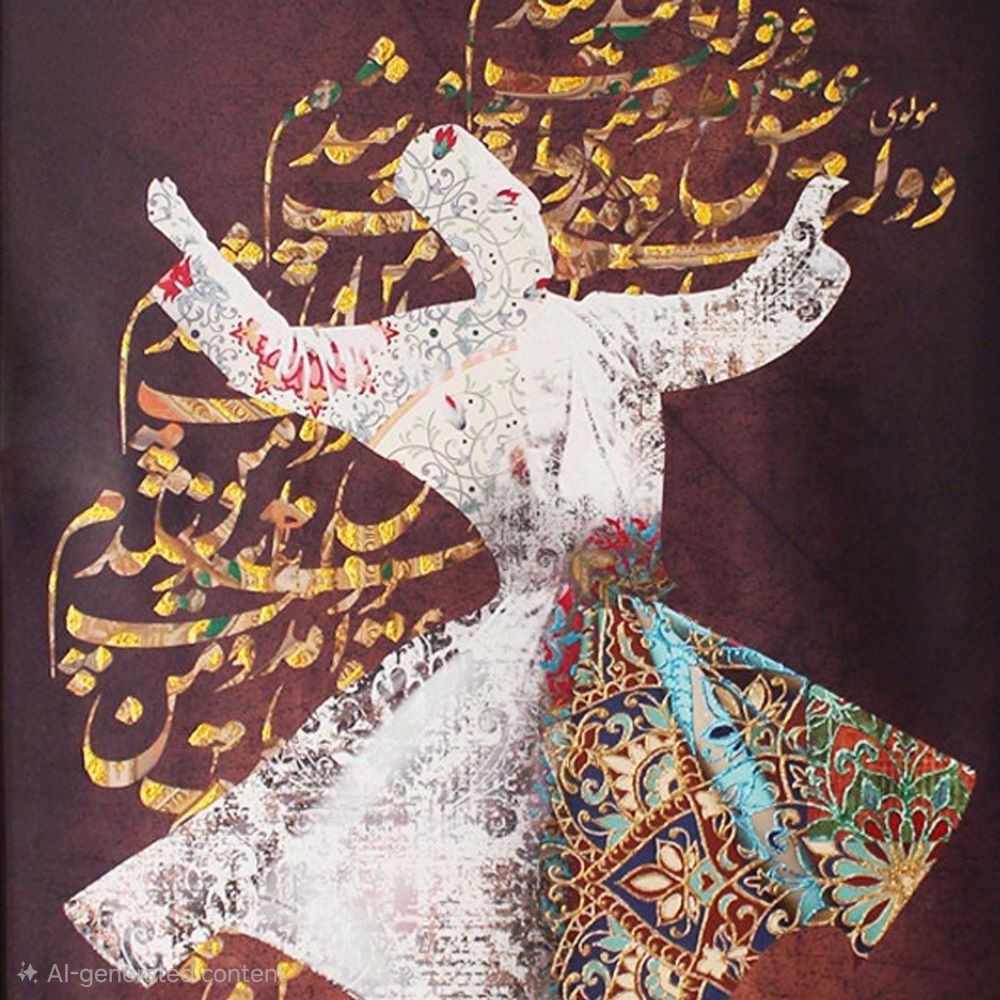
What is love? Perfect thirst. So let me explain the Water of life
Rumi oscillates between the unsayability and his urge to describe. He dwindles between uttering and retracting.
Whatever I say of love, I am ashamed when love arrives.
However, this is not inconsistency but it is fidelity to experience.
Although the commentary of the tongue makes all clear, yet tongueless love is clearer
These lines distill the entire epistemiology of Rumi’s love. While tongue explains, love reveals. Explanation comes from the realm of signs and revelation from the realm of presence.
because I am thy lover; love makes blind and deaf
Senses are instruments of distance and they require the beloved “over-there“. Love makes us blind and deaf. It abolishes distance by breaking the fetters of mediation so that the lover is already with Him. Thus, love is allied with a sense of liberation that Rumi conceives as the essence of Man.
My secret is not far from my plaint, but ear and eye lack the light (whereby it should be apprehended). Body is not veiled from soul, nor soul from body, yet none is permitted to see the soul.
Love brings man’s annihilation and subsistence and therefore it transcends the intellect. Philosophy attempts to find a thread of Truth by understanding the phenomena through senses; senses that Love shuns out. In words of Rumi, “there is squint in the eyes of intellect”. Rumi believes in immediate intuition over intellectual hairsplitting, he calls it Ishq, and expresses it as something that could unveil the truth and at the same time tells us as to why it is not communicable. The identification of Love with immediate cosmical intuition reveals the number of utterances of Rumi which would otherwise appear to be irresponsible and extravagant.
Then what is love? The sea of Not-being: then the foot of the intellect is shattered
For Rumi, God is the source of all love. As the “coincidence of opposites” God possesses all His attributes absolutely, yet in His Essence He is not limited by any one of them and transcends all of them. He is Love, but from another point of view He is beyond Love. Love names His self-disclosure and transcendence names His reality. Both of these views are seen in Rumi’s poetry.
Love is affection beyond bounds. Hence it is said that Love is truly God’s Attribute, while it is the attribute of His servants only in a derivative sense. He loves them is everything. What then is they love Him?

According to Rumi, God’s essence is beyond all need but it was God’s Love for manifesting the Hidden treasure that motivated His creation of the universe. As a result, Love and the divine Will courses through it- not as an accident but as its very principle. Not only this, cosmos is not only made by love; it is also sustained through it. From the turning of the spheres to the restlessness of the human heart, all motion is a yearning to return to the source from which it emerged. Love is the bond between the Hidden and the manifest, the secret that animates all becoming.
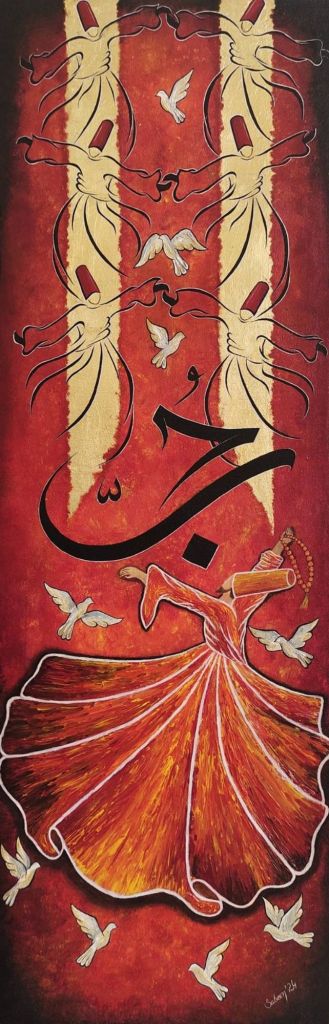
The creatures are set in motion by Love, Love
by Eternity-without-beginning; the wind dances because of the spheres, the trees because of the wind.
The world is like a mirror displaying Love’s perfection. Oh friends! Who has ever seen a part greater than its whole?
The world as maintained by love participates in the God’s love. Each existent is infused with need for other existents that are constantly striving to gain proximity with each other. These immediate loves: partial, finite and sometimes situational, are source of all movement and activity.
God’s wisdom in His destiny and decree has made us lovers of one another
An interesting conundrum arises with Rumi in the love for other and he resolves it rather meticulously. For Rumi the love of other derives from the love for Him. One by one man turns to love for other, investing in them with absolute devotion until they inevitably reveal their unfaithfulness; man turns his love elsewhere and elsewhere and elsewhere, until he finds the true Beloved. Some still don’t find Him until only after death when it is too late to close the gap of separation. True beauty pertains only to God, man turns from beauty of other when he realises that it is only borrowed and ephemeral and true beauty emanates from His Being.
Finite forms attract because they reflect the Divine; once this is understood, love is gathered back to its source, and the apparent multiplicity of seeking ultimately resolves into a single journey toward unity: A movement of return. What wounds the lover is not the failure of love itself, but the misrecognition of its object.
In whatever state you may be, seek! Seek water constantly Oh man of dry lips
For your dry lips give witness that in the end you will find a fountain
Seeking is a blessed movement, seeking kills obstacles on the way to The Beloved
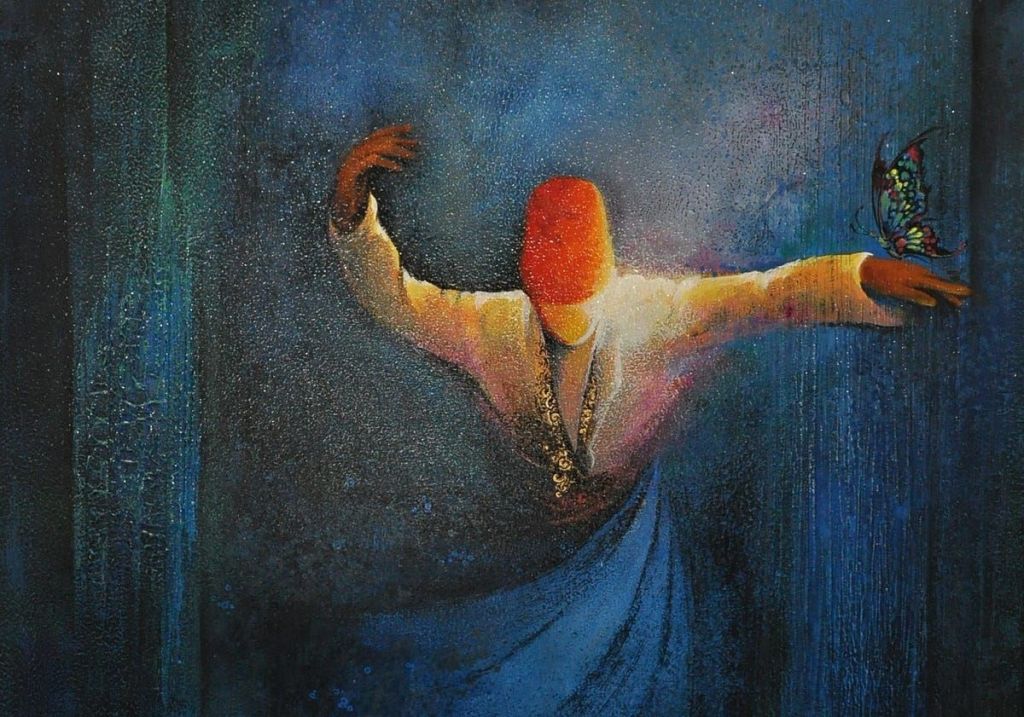
In Rumi, Love remains unfinished as it must. The lover keeps arriving, away from explanations towards the presence. The reed keeps singing not because it has found the source but because it has never forgotten it.
The fountain is not elsewhere and TO SEEK IT IS ENOUGH.
God’s Love and the mystery of His “contemplation of the witness” are the foundation of all his veil making.
(Italics: Translations from Mathnawi and Fihi-ma-Fihi by R. Nicholsan and W. Chittick)
 The K-Blog
Leave a comment