The political decline of the Mughal, Ottoman and Safavid Empires in the eighteenth century did not signal a period of cultural and political stagnation for Muslims. Various Islamic revivalist and reform movements were born out of the need of the Muslims to situate themselves within this re-evolving political context. The major influx of modern ideas and intellectual methods was concomitant with the establishment of the colonial state in the wake of the suppression of the mutiny of 1857 and disempowerment of Muslims both within and beyond India. The new political context served as an impetus for the community to discuss the utility and futility of adopting modern institutions and facets of Western civilisation.
Polemical works by missionaries and burgeoning orientalist literature evoked sharp responses from the Muslim intellectuals. Maulvi Chiragh Ali, for instance, acknowledged that his own re-assessment of Islamic institutions was a response to the writing of Malcolm MacColl, the Canon of Ripon, who wrote a series of books critical of the Ottomans, describing Islam as a rigid system that promoted theocratic and illiberal societies. Even before this period, driven by the fall of Muslim society, there were scholars like Shah Waliullah who attempted to shape an Islamic intellectual and theological response to the decline of the Mughal Empire, providing an intellectual interaction with Western political discourse that Muslim writers continue to draw upon.
However, the late nineteenth and twentieth centuries proved to be a time of great ferment in the history of Muslim India, in which perceived challenges to Islamic thought were more urgent and the responses more varied. Literature and poetry became the sites for debating the Muslim decline and inventing discourse to fight the onslaught of colonialism, reflecting a new communitarian ethos.
Khwaja Altaf Hussain Hali reflected the spirit of the times when he wrote:
Pasti ka koi hadd se guzarna dekhe
Islam ka ghir kar na ubharna dekhe
Maane na kabhi ki mad o jazar ke baad
Darya ka hamare to utarna dekhe
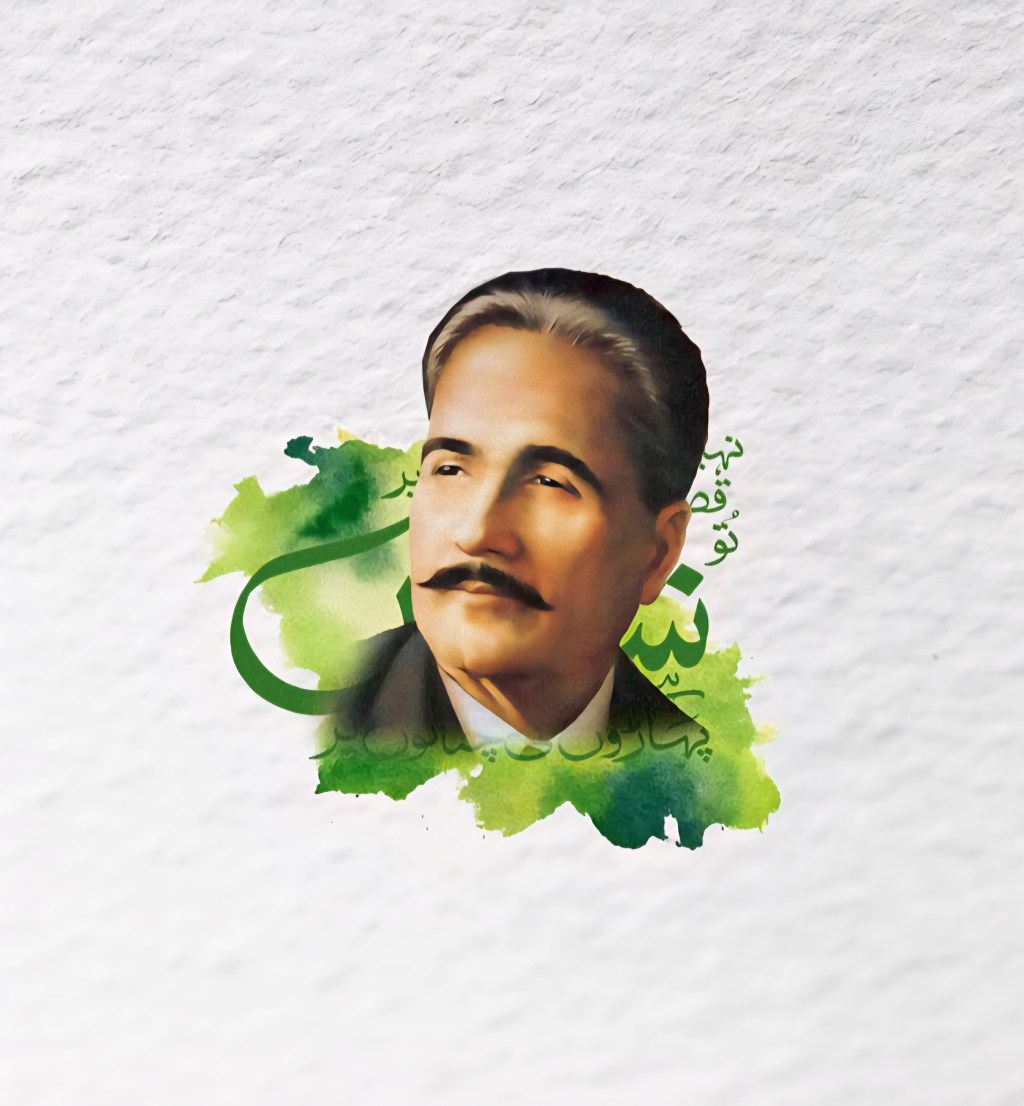
One of the most fascinating intellectual transformations in modern South Asian history is Iqbal’s journey from unabashed national fervour to a universal religious solidarity.
The transformation remains an open academic debate and continues to shape Muslim political thought until this date. In his poem “Hindustani Bachchon Ka Qaumi Geet” (The National Song of Hindustani Children), composed before 1904, Iqbal celebrated India’s syncretic heritage:
“Chishti ne jis zameen par paigham-e haq sunaya,
Nanak ne jis chaman mein wahdat ka geet gaya”
(The land where Chishti delivered the true message,
the land where Nanak sang the song of unity)
His early nationalism was not premised on exclusions but remained refreshingly inclusive, transcending the communal divisions that were hardening around him during this period. It was based on the refreshing engagement with the landscape of India and its accommodative character. He would later describe this patriotic fervour as “poetic universalism”.
In The Dawning of Nations, Walker Connor observes that a meaningful study of nationalism demands that scholars avoid using the term nation as a stand-in for the state. Without understanding Iqbal’s effort to define a distinct space for the “nation”, one that transcends the territorial limits of the modern state, it is impossible to grasp the true essence of his political thought. Efforts to connect Iqbal’s idea of nationhood directly with the creation of Pakistan have often led to serious misunderstandings of his philosophy. Even those who acknowledge Iqbal’s belief in the non-territorial character of the Muslim nation have struggled to reconcile his vision of Pan-Islamism or universal brotherhood with the concept of territorial nationalism.
After having travelled to Europe Iqbal encountered territorial nationalism’s dark side. According to his son Javed Iqbal, “the biggest revolution with respect to Iqbal’s stay in Europe was his distancing from nationalism”.
In a crucial letter to Waheed Ahmad Masood Badayuni dated September 7, 1921, Iqbal reflected on this pivotal moment:
“At this point the severest enemy of Islam and the Muslim world is racism and the idea of territorial nationalism. It has been 15 years when I first analysed it. At that point I was in Europe and this feeling had brought about a remarkable revolution in my thoughts. The fact remains that Europe’s atmosphere made me a Muslim.”
This letter reveals that by 1906–1907, barely a year into his European sojourn, Iqbal had begun his systematic critique of territorial nationalism. He came to view European nationalism not as a model for political organisation but as a dangerous ideology that divided humanity and promoted “cut-throat competition between nations”. His criticism of nationalism was based on moral and spiritual factors. In his opinion, homeland in Europe was given the status of a deity, started to be worshipped as god and meant end to religion. He also believed the doctrine of territorial nationalism was a source of perpetual conflict because it divided humankind and led to war. His criticism was both theological and philosophical. In his famous Urdu poem “Wataniyat” (Patriotism), he deployed powerful imagery to condemn territorial nationalism:
“In taza khudaon mein bara sab se watan hai
Jo pairahan is ka hai woh mazhab ka kafan hai”
(Country is the biggest among these new gods!
What is its shirt is the shroud of religion)
The poem continues with a devastating indictment of nationalism’s effects:
“Aqwam-e-jahan mein hai raqabat to issi se
Taskheer hai maqsood-e-tijarat to issi se
Khali hai sadaqat se siasat to issi se
Kamzor ka ghar hota hai gharat to issi se”
(The antagonism among world’s nations is created by this alone;
Subjugation as the goal of commerce is created by this alone;
Politics have become bereft of sincerity by this alone;
The destruction of the home of the weak is by this alone)
In his Persian work “Javid Namah,” speaking through the voice of Jamaluddin Afghani, he wrote:
“Lurd-i-maghrib aan sarapa makr-o-fan
Ahl-i-deen ra dad taleem-i-watan”
(The Western lords, in their deceit,
Have taught the faithful the cult of nation-worship)
In his letter to Professor R.A. Nicholson, Iqbal explained his position as thus:
“Since I find that the idea of nationality based on race or territory is making headway in the world of Islam, and since I fear that the Muslims, losing sight of their own ideal of a universal humanity, are being lured by the idea of a territorial nationality, I feel it is my duty as a Muslim and a lover of all mankind, to remind them of their true function in the evolution of mankind. Tribal or national organisations on the lines of race or territory are only temporary phases in the unfoldment and upbringing of collective life, and as such I have no quarrel with them. But I condemn them in the strongest possible terms when they are regarded as the ultimate expression of the life of mankind.”
The nation-state, by relegating religion to the private sphere, created what Iqbal saw as a false separation between the temporal and spiritual realms. This secularising tendency threatened to transform human beings from servants of God into worshippers of territorial idols. He argued that territorial nationalism’s emphasis on territorial boundaries and racial distinctions fundamentally contradicted Islam’s universal message. In his 1930 Allahabad Address, he explained: “Islam does not bifurcate the unity of man into an irreconcilable duality of spirit and matter. In Islam, God and the universe, spirit and matter, Church and State, are organic to each other”.
Iqbal engaged in a public debate with a leading Deobandi scholar, Hussain Ahmad Madani, in April 1938 over the issue of territorial nationalism. Madani quoted extensively from the Quran and other Islamic sources to argue that Islam sanctioned the founding of political community upon the basis of territory. However, Iqbal debated against Madani and many of his ideological contemporaries, arguing that adaptation of modern political ideals and institutions such as nationalism would require a radical transformation of the structure of Islam itself. As he wrote to Syed Muhammad Saeduddin Jafri on November 14, 1923:
“According to me, Islam is a practical means of taking the human race above geographical boundaries and racial and nationalistic differences…
Recognizing the political realities of his time, Iqbal eventually developed what scholars call “Muslim nationalism”—a synthesis that retained nationalism’s structural format while grounding its ethos in Islamic principles. This was not a capitulation to territorial nationalism but an attempt to provide Muslims with a political framework that would preserve their religious identity.
However, Iqbal was careful to distinguish this from European-style nationalism. Critiquing the tendency of intellectuals and statesmen in the colonised world to mimic development patterns of the West, Iqbal stressed that nations ensured their development only by remaining true to their specific characters. Both the individual and the nation secured their development through the process of self-discovery. Iqbal’s aim was to articulate a “partly political, partly cultural” programme which would ensure that nations developed in accordance with their own national character. As he noted: “The construction of a policy on national lines, if it means a displacement of the Islamic principle of solidarity, is simply unthinkable to a Muslim”.
Throughout his critique of nationalism, Iqbal maintained his commitment to pan-Islamic solidarity. In his correspondence, he consistently emphasized Islam’s universal message. Writing to Jafri, he explained:
“You consider Pan-Islam to be a political or national movement. According to me it is a means of bringing a few human nations on one platform. That way these nations will be free from racial, national and territorial differences. Thus Islam is a step towards unity of the human race”.
This vision transcended the narrow confines of territorial nationalism to embrace what Annemarie Schimmel called the “supra-nationalism of Islam”. For Iqbal, true Islamic politics would eventually lead to a world free from the artificial divisions that nationalism created.
In his lectures he concludes:
“It seems to me that God is slowly bringing home to us the truth that Islam is neither Nationalism nor Imperialism but a League of Nations which recognizes artificial boundaries and racial distinctions for facility of reference only, and not for restricting the social horizon of its members.”
Iqbal’s journey from territorial nationalism to Islamic universalism represents more than mere intellectual evolution; it embodies a fundamental tension within modern Muslim political thought. Iqbal’s critique of nationalism remains strikingly relevant in our contemporary world. His warning about nationalism’s tendency toward “competitive nationalism and its resultant militarism, imperialism and consumerism” anticipated many of the conflicts that have plagued the modern world, like the ongoing Gaza genocide, where territorial allegiances have weighed heavily over the supra-territorial ethical and moral responsibilities of Muslim nation-states. Iqbal’s intellectual odyssey, with all its tensions and contradictions, provides invaluable guidance for navigating these enduring challenges.
زوریز، چراغِ فروزانِ دانایی باش
 The K-Blog
Leave a comment