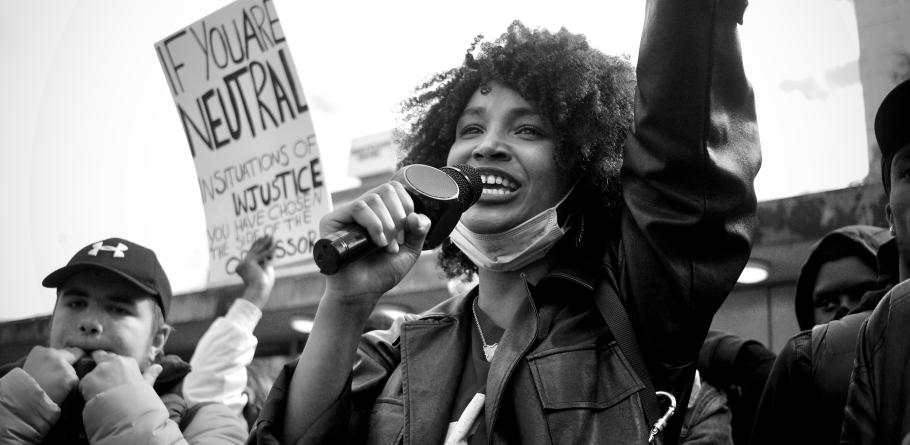
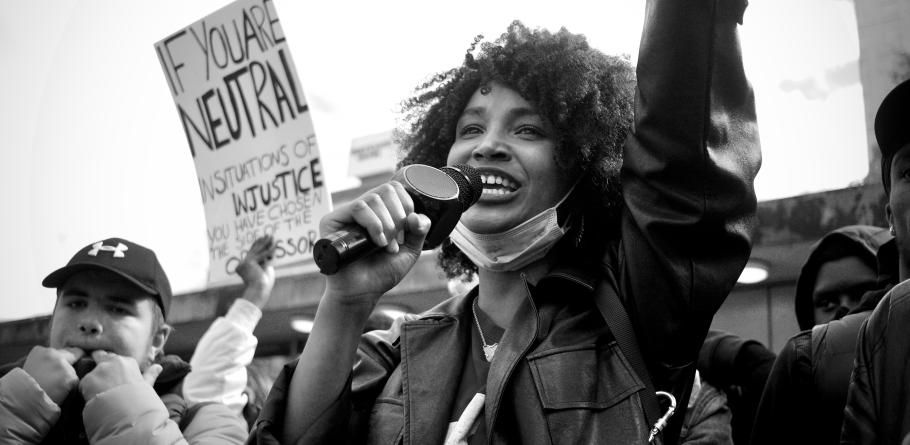
The true speech is the one that is not institutionalised. The true self is the one which is not subjectified. The true language is that of breaking free.
Language as freedom:
The essence of human ego is its ‘will to choose’ and ‘will to express’ and hence the beginning and end of all philosophy is freedom. According to F.W.J. Schelling, “The thought of making freedom the sum and substance of Philosophy has emancipated the human spirit in all its relationships and has given to science in all its parts a more powerful reorientation than any earlier revolution.” To expound upon the nature of man, Jean-Jacques Rousseau, a Genevan philosopher whose thoughts influenced the Enlightenment and the French Revolution, tries to draw a parallel between man and animal and concludes that “Man is intelligent and free… and endowed with reason” unlike animals who are “devoid of any intelligence and freedom.” All animals are ingenious machines which have been given senses by the Almighty to protect themselves and to revitalise, the only difference between the human and the animal being that in the case of the beast all operations are determined according to a rule where the beast chooses and rejects by a predetermined instinct, however in the case of a man: he chooses by an act of freedom. Immanuel Kant believed that a culture of enlightenment was “almost inevitable” if only there was “freedom to make public use of one’s reason in all matters” and, commenting upon the French Revolution, he exclaimed that “one must be free to learn how to make use of one’s powers freely and usefully.” Thus the essence of human nature is man’s freedom and his consciousness of his freedom, and it is by this ‘will to choose’ that a man is differentiated from lower animals that follow involuntary predetermined mechanical principles of nature. This “will to choose” becomes the greatest sign of humanity, and one of the prime expressions of this virtue becomes language. To the Cartesians every human possesses a mind, whose essence is thought, and this freedom of thought is reflected in his creative use of language. Chomsky, on this correlation between free thought and language, goes on to explain: “There is an interesting connection between language and freedom. Language, in its essential properties and in manner of its use, provides the basic criterion for determining that the other organism is a being with a human mind.” In Cartesian philosophy the creative language should be free from control by an identifiable stimulus so as to be coherent and engender free thoughts and ideas. Language thus becomes a prime playground for cognitive, communicative, social and political identities, where power–language dynamics play a major role, manoeuvred, augmented or concealed to convert one power into the other. The control stimuli in language are introduced by various social and political institutions to exert or maintain dominance over language and hence over the intangible it expresses, i.e. the free creative thought. Language is deeply imbricated in the flesh of civilisation.
Language as power:
Language reveals power and it reflects power. It is the vortex of human liberty and hence it is fiddled with, to curtail that liberty and enforce slavery upon minds and bodies. Corporates use it to create influence through conversations and debates. Politicians use it as a tool or a playground for exercising authority. All systematic uses of language are seen as having power-enforcing functions. The language-driven power play is not only found in formal contexts like the parliaments and courts of law but is palpable all around, as we can see today, in media, on social media, TV entertainment, pop songs, the broadsheets of the day, and in things which may seem trivial like pictures on a packet of butter. Sometimes these functions lie below perception and are not explicit and become so intricate to our society that we deem them to be an intimate part of language, as if they are facts about its nature rather than politically driven constructions. This language–power exchange can be found in Foucauldian discourse analysis. Michel Foucault calls out the premises of “subjugation at the level of language” in his Incitement to Discourse. He believes that without something to define an idea, to place it within specific parameters of meaning and context, the idea is left formless and cannot exist within the human mind. Foucault clearly recognises the power that language holds over existence and the social, political and metaphysical ramifications that arise from its alterations. Foucault was particularly concerned with the systems of talk within the limits of various disciplines such as medicine, law or business. Such discourse systems, he maintained, control how we think and how we know. Power, for Foucault, is a “matter of how discourse constrains what we can know.”
Language creates influence through oratories and narratives. In an elaborate study paper by Ski Hung Ng in 2007, he explains how language “maintains and reproduces existing dominance.” He talks about speeches such as Susan B. Anthony’s “On Women’s Right to Vote,” Winston Churchill’s “We Shall Fight on the Beaches,” Mahatma Gandhi’s “Quit India,” or Martin Luther King Jr.’s “I Have a Dream,” and how a speaker may, by the sheer force of oratory, “buoy up people’s hopes, convert their hearts from hatred to forgiveness, or embolden them to take up arms for a cause.”
Hinchman described narrative as a discourse “with a clear sequential order that connect[s] events in a meaningful way … thus offer[ing] insights about the world and/or people’s experiences of it.” All texts, histories and truths take a narrative form. Narrative power through media and social media has influenced the socio-political dynamics worldwide. Political actors worldwide have become increasingly aware of the power of storytelling in international politics, as was clearly seen in the recent American elections. Trump’s rhetoric relied mostly upon narrative form and even though most of his claims were usually dubious, the narrative, because it resonated with a large section, helped him secure 7.39 crore votes, even after his dismal performance in controlling the pandemic. The same could be true about the current regime in India, which, despite its terrible record as far as the Indian economy and communal politics are concerned, could again emerge triumphant in upcoming elections.
Language as subjugation:
The world seems to be crumbling under the burden of its own misgivings and unfortunately it has taken to the Far Right as an imaginary saviour. The only coherent notion seems to be that of subordinating and marginalising those outside the powerful systems of capitalist-driven racial hatred, which is very conveniently driven by negation of the cultural and symbolic legitimacy of the Other. Society, in Michel Foucault’s Kafkaesque rewrite of Orwell’s 1984, suffers from a “universal panopticism”; a state in which society is a jail where the inmates cannot know when they are being watched, which means that they are motivated to act as though they are being watched at all times. Thus, the inmates are effectively compelled to regulate their own behaviour. Foucault used the term to show how the disciplinary regimes use it to subjugate the citizens who go against its constants of right and wrong. Amidst a massive media presence, opinion-making and opinion-control remain central to constraining all the self-conscious assertions of the marginalised against dominant right-wing discourses. A sixty-minute TV debate in an AC room can be enough to trigger massive riots in New York; a random video posted on YouTube can drive an already disillusioned white supremacist to butcher dozens of innocents in a New Zealand mosque; a few speeches by politicians, broadcast over and over again with utmost servile candour, can throw the streets of New Delhi into a spasm of smoke and blood. Language has been used to pre-define, classify and establish hierarchies. Edward Said’s Covering Islam explains in great detail how killing Muslims, plundering their lands and, most of all, dehumanising them was normalised and universalised: largely by the second front (after the military) of the West, i.e. their media.
Reclaiming language and freedom:
Fanon explains that “to speak means to be in a position to use a certain syntax, to grasp the morphology of this or that language, but it means above all to assume a culture, to support the weight of civilisation.” A man who conforms to a certain language, subconsciously, gives allegiance to the world expressed by it.
In current times language and terms of political discourse have a meaning different from their real meanings—the meaning that is useful only for serving interests of the powerful: the doctrinal meaning. The function of the doctrinal meaning is to make it impossible to find words to talk about matters significant to human life and dignity, to impose a distortion such that the major ‘corporations’ remain sure that the general masses know little about how society is made to work. Take “Democracy” for example: the dictionary explains it as governance of affairs of people by people themselves, with their meaningful participation in managing those affairs. But in political discourse it is a system where decisions are taken by an elite few from the business, political and media community. The public are only spectators. They are Walter Lippmann’s “spectators of action” who are supposed to follow orders and keep out of the way of the important people; they are the “bewildered lot.” Again, peace is a concept of societal friendship and harmony in the absence of hostility and violence. But current definitions of peace mean anything but peace. The ‘doctrinal’ peace very conveniently means protection of illegitimate authorities of social, political, economic and cultural powers all over the world. If the ideas of justice and dignity try to question them, these corridors turn ‘peace’ and ‘way to peace,’ which once meant absence of hostility, into the most ruthless of all vendettas of violence until every opposition is ideologically and physically torn down. “Peace” has been prostituted by every era of power-hunger and political conceit; it has been given every meaning other than what it actually meant. The same holds true for hundreds and thousands of terms we hear in news, read in newspapers and tabloids, and hear politicians speak. The orations and narrations need to be deconstructed.
People need to revisit the real meanings; they need to break these programmed doctrines of doctored discourses to understand how the world really works. The true speech is the one that is not institutionalised. The true self is the one which is not subjectified. The true language is that of breaking free.
 The K-Blog
Leave a comment