
Translated by Khawar Khan Achakzai
(Only a few copies of magazine Sheeraza remain, one in the dust smitten library of the translater, gifted to him by a close associate and friend of Late. Shameem Ah Shameem, Dr Ab. Wahid. The interview is translated verbatim)
This is on 18th February 1967 and what a beautiful night it was. Me and my hosts: Meer Qayum, Meer Manan and Amanullah Khan were going to the house of my muse, Faiz Ahmad Faiz. Faiz had informed us about the address of his place and Qayum Sahab was racing his car towards the destination, as if he had sensed my restlessness and was probably experiencing the same. After some time the car stopped in front of a majestic cottage, and we were intimated that Faiz Sahab was waiting for us in the upper storey. We were about to enquire the exact location of the room when my attention was caught by statues and paintings on walls and I was convinced that this must be the way into Faiz Sahab’s room. I was right!!
On both sides, small art samples were beautifying the stairs and the walls were covered with works of renowned painters. I knocked on the door gently. The door opened. Faiz stood in front of me. For a moment I was spellbound, blank and had no idea what to say. While I was still trying to gather myself, Meer Manan Khan introduced me to him. We were invited in, and inside the room sat a tall, beautiful and a graceful lady, who was completely engrossed in her studies, she did not even notice us coming in. She was Allys Faiz. Faiz Sahab introduced us to her and she welcomed us warmly, speaking in her impeccable Urdu.
While all of us sat down, I noticed the latest issue of ‘Soviet Literature’ lying by. Faiz had probably been reading it before our arrival. Before we would start our conversation I had a thorough look around the room which looked like his study room, it was decorated in books; one corner hosted Lenin’s picture and the walls were adorned with abstract paintings. There were some pictures of his daughters Muniza and Saleema with their husbands on a wall. There was no radio or television in the room, however, occasionally the telephone would ring to unsettle the solace of the room.
“Since when are you in Pakistan”, Faiz Sahab asked me.
I could see excitement blooming on his face, the same refreshing excitement which was often palpable in his poetry
“I have been here for a month. I had a great desire to meet you, both Sheikh Sahab and Sadiq Sahab kept talking of you,” I said.
“Yes, I have met Sadiq Sahab several times but couldn’t meet Sheikh Sahab after 1946. I had thought that I would meet him when he visited Pakistan in 1964, but due to passing away of Pandit Nehru all the plans broke down,” Faiz said.
An elixir of a smile spread on his face and he asked me, “Do you know that Sheikh Sahab read my Nikah and Sadiq Sahab, Bakshi Sahab and Dr Noor Hassan, K.H. Khursheed signed as witnesses. In this way, my nikah paper is a historical document.”
“When was the last time you visited Kashmir,” I inquired.
“Last time it was in 1947. 15th of August 1947 (to be precise). When the subcontinent was partitioned I was there only. I left Srinagar on 24 August. The fight of Kashmir had started, which instead of getting solved, was entangling day after day,” he added.
The journalist in me forced me to ask him, “What do you think is the reason of this problem?”
Faiz: Brother this is such a complicated issue. An easy solution is already difficult and to add to it both the sides have taken extreme positions over it. With such extreme positioning, the chances of its solution with dialogue are decreasing day after day. The governments of both countries are competing in extremism and hence a meaningful dialogue seems difficult. There could however be one thing. Both countries without compromising their stands could start the dialogue process. China and America should serve as an example, who despite their differences, kept on meeting in Warsaw (Poland). In the same way, India and Pakistan should also meet in a third country and chalk out a way of understanding and reconciliation.
But the current position is that Pakistan says that the Kashmir issue is the core issue and should be solved, while India says that there is no issue at all. I believe not admitting the basic truths is wrong and I have said this to many of my friends in India. Recently, during my brief visit to India many friends told me that they would satisfy the Kashmiris, but they feel even after that, Pakistan would not be happy. I told them if Pakistan wouldn’t be happy then Pakistan’s argument would lose the all the strength.
Faiz talked calmly, the innocence and composure of his speech made his character even more charismatic. He wasn’t saying anything new, but the tenor and tonality he spoke in gave an aura of some secret being revealed. I felt that Faiz’s heart ached for Kashmir. He told me something I had never heard from anyone else in Pakistan. “The best solution for Kashmir would be if both countries give up their claims on Kashmir and Kashmir becomes an independent country and establishes friendly relations with both India and Pakistan. This is what will happen in the end but after a lot of damage. You must convey same to both sides,” he said.
“What do you think of the current revolution?”, I asked. The question was regarding the protests in Pakistan against Ayub Khan, the then president of Pakistan.
Faiz: “Right now it is just confusion. Maybe after this confusion is over there might be a way out. The current protests are a reaction to restrictions on freedom of expression that were imposed over last ten-eleven years. Ayub Khan’s biggest mistake was that he closed the doors to differences of opinion, and now he has to listen to the criticism for all those 10 years”
I wanted to change the topic now. I wanted to discuss poetry and literature, so I asked, “You have written something there”, he replied: “I keep on writing” and went into deep thought, “Wait! Let me see if any of my books is here. Please take it for Sheikh Sahab”, he went into the room.
I was wondering and take with a surprise at his modesty. Did the master writer of “Naqsh-e-Faryaadi”, “Daste-e-Saba”, and “Zindan Nama”, the pinnacles of literature even realize how great a poet he was, how accomplished an artist and how beautiful a person he was? His simplicity, humility and kindness alluded to the fact that Faiz never thought of himself as someone great. I kept thinking.
While Faiz went inside, searching for a book that he would gift Sheikh Abdullah, I enquired about their daughters from Begum Faiz (Allys). Allys, while pointing towards their photos, said that both the girls were married and Saleema was a painter and the art adorning the walls was hers. Allys found a lot of pride in her daughter’s work. She went on, “Saleema is a painter and Muniza is a television producer. When Sheikh Sahab would come to our home in Rawalpindi both of them were very young.” Allys mentioned Sheikh Abdullah’s name with the utmost respect and I felt that she still thought very highly of him.
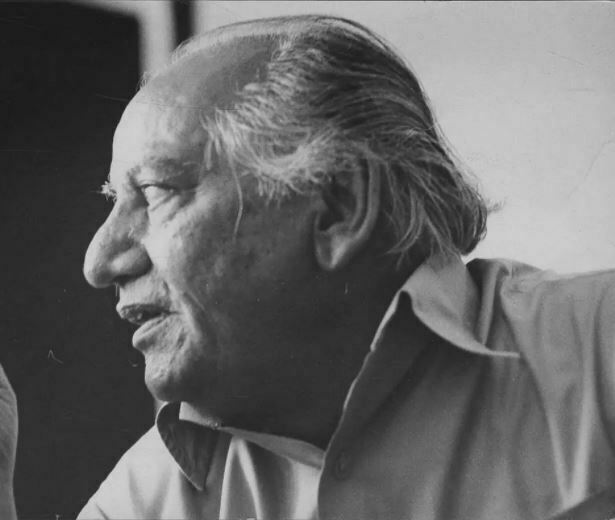
After a while, Faiz came back, disappointed that he couldn’t find a book and said. “I did not find a book. Now I will write a ghazal to Sheikh Sahab.” He held a pen in his hand and Begum Faiz went to prepare tea for us. While he was writing I could see how the flow of time had imprinted its marks on his face and how in-spite of those marks of journey, the enthusiasm on his his face would mask the signs of ageing. He would have been very handsome when he was young. Allys came in with tea and asked Faiz what was he searching for. He said that he was looking for a book that he could send to Sheikh Sahab. Hearing this Allys said that if it was for Sheikh Sahab she would do it herself. She came back with a copy of “Naqsh-e-Faryaadi” and “Intikhab-e-Faiz’. She scribbled Sheikh Sahab’s name on “Intekhab-e-Faiz” and my name on “Naqsh-e-Faryadi” and passed both of them to me.
Faiz said that apart from Sheikh Sahab and Bakshi Sahab he had many friends in Kashmir, and he had recently met one in Moscow. He was referring to Durga Prashad Dhar. “I quarrelled with him”, I said, to which he smilingly replied, “You politicians often quarrel with each other”.
I asked him about his friendship with Ali Mohammad Tariq. “Yes, he too is my friend, where is he nowadays? He has stolen two of my books. Say my Salaams to him as well”
“Why don’t you come to Kashmir. How lovely it would be to have you there again,” I asked.
Faiz: I have a desire of coming to Kashmir. I have spent some of the best days there. But going there in the current situation is difficult, but yes, Begum Sahiba can pay a visit”
Now I turned to Begum Faiz and asked invited her to visit Kashmir. “Yes, I can visit because I have a British passport. When Faiz sahib was jailed in Rawalpindi conspiracy case, my Pakistani passport was cancelled. Now I just have a British one,” she said.
Faiz replied in a very sad voice.
“I don’t understand why poets, sportsmen and artists have been barred from travelling when they can play a great role in promoting good relations, understanding and friendship between the two countries. It looks like even arts and sports have been politicized. The outcomes of such politicization will be bad,” he warned.
The beautiful time was over so fast. I stood up and asked for leave. Faiz Sahab stood up to see me off. I asked to hug him and I embraced not only my most loved poet but my beloved.
 The K-Blog
Leave a comment